The Slip-On Revolution — Why Trudave Gear Is Redefining What a Rain Boot Should Feel Like, Fit Like, and Do
You know the scene. It’s 5:00 AM. The dog is pacing by the back door. The grass outside is soaked with the kind of heavy dew that soaks through sneakers in under thirty seconds. You’re standing there, still half-asleep, staring at a pair of lace-up boots that require two hands, a bent knee, and enough fine motor control to thread wet laces through frozen eyelets. And somewhere in the back of your mind, a quiet voice asks the question that has launched a thousand gear revolutions: is this really necessary?
If you’ve spent any time on the outdoor corners of TikTok lately, you’ve seen the debate unfold in real time. The traditionalists argue that if a boot takes less than five minutes to put on, it’s not a “real” work boot. The slip-on advocates fire back with a simpler proposition: work smarter, not harder. The debate usually boils down to two things: speed versus stability. And for a long time, the slip-on boot came with an implicit compromise — you gained convenience, but you sacrificed fit, support, and protection.
That compromise is no longer necessary. Trudave Gear has built its rain boot lineup — BloomBoot, MudTrek, HeatHold, MudFlex, GardenStride, and GreenStep — around a design philosophy that refuses to accept the old trade-offs. The slip-on boot doesn’t have to be loose. It doesn’t have to be clunky. It doesn’t have to be the boot you settle for when you can’t be bothered to tie laces. It can be the boot you choose because it fits better, flexes with your foot, keeps water out more reliably, and gets you out the door faster than anything with laces ever could.
This is the story of that revolution. How modern materials and smart design are closing the gap between convenience and performance. Why the laces that generations of boot buyers assumed were essential might actually be holding you back. And where each Trudave rain boot fits into a philosophy that treats slip-on design not as a compromise, but as an upgrade.
Part 1: The Great Boot Debate — Why Laces Are Losing
The argument for lace-up boots has always rested on two pillars: fit and ankle support. Laces allow you to customize the tightness around your foot and lower leg. Cinch them down, and the boot becomes an extension of your foot. Leave them loose, and you can wear thicker socks. The adjustability is real, and for certain applications — logging in the Pacific Northwest, framing a house on a steep roof — it remains essential.
But for the vast majority of what people actually do in rain boots — gardening, dog walking, farm chores, commuting in wet weather, running errands in the rain — that adjustability comes with a hidden cost that nobody talks about in the store.
Laces soak up water. They freeze in winter. They collect burrs and thorns and every seed head within a three-foot radius of the ground. When they get caked in mud — and they will get caked in mud — untying them becomes an exercise in archaeology: scraping off dried dirt with frozen fingers while the dog whines at the door and the rain picks up. This is the fatal flaw of lace-up rain boots that doesn’t appear on any spec sheet but reveals itself within the first week of ownership.
The slip-on design, by contrast, presents a cleaner, simpler proposition. As one analysis of the slip-on versus lace-up debate notes: “In terms of upkeep, slip-on boots are generally easier to maintain than their lace-up counterparts. Their simple, streamlined construction presents fewer areas for dirt to accumulate and fewer components that can wear out or break, such as laces and eyelets.” When you’re dealing with mud, manure, and wet grass on a daily basis, “fewer areas for dirt to accumulate” isn’t a minor design preference. It’s a functional advantage that compounds every single time you wear the boots.
But the most important shift isn’t about maintenance. It’s about how modern materials have changed what a slip-on boot can do. The old objection — that slip-ons can’t fit as snugly as lace-ups — was true when slip-ons were just rubber shells with no structure. It stopped being true when brands started incorporating neoprene uppers, elastic side gussets, and engineered heel cups into their slip-on designs. Trudave’s approach to this problem is instructive: instead of using laces to create a custom fit, they use flexible materials that conform to your foot and leg without the need for mechanical adjustment. The fit is built into the boot’s architecture, not achieved through tightening.
Part 2: How Trudave Solved the Slip-On Fit Problem
The engineering challenge at the heart of the slip-on revolution is deceptively simple: how do you build a boot that slides on easily but doesn’t slide around once it’s on? Traditional slip-on rain boots solved this problem by being loose everywhere — easy to put on, but with a fit that felt more like a bucket than a boot. The heel slipped. The arch got no support. The foot worked harder than it needed to with every step.
Trudave’s solution involves three design elements working in concert, none of which were available to boot designers a generation ago.
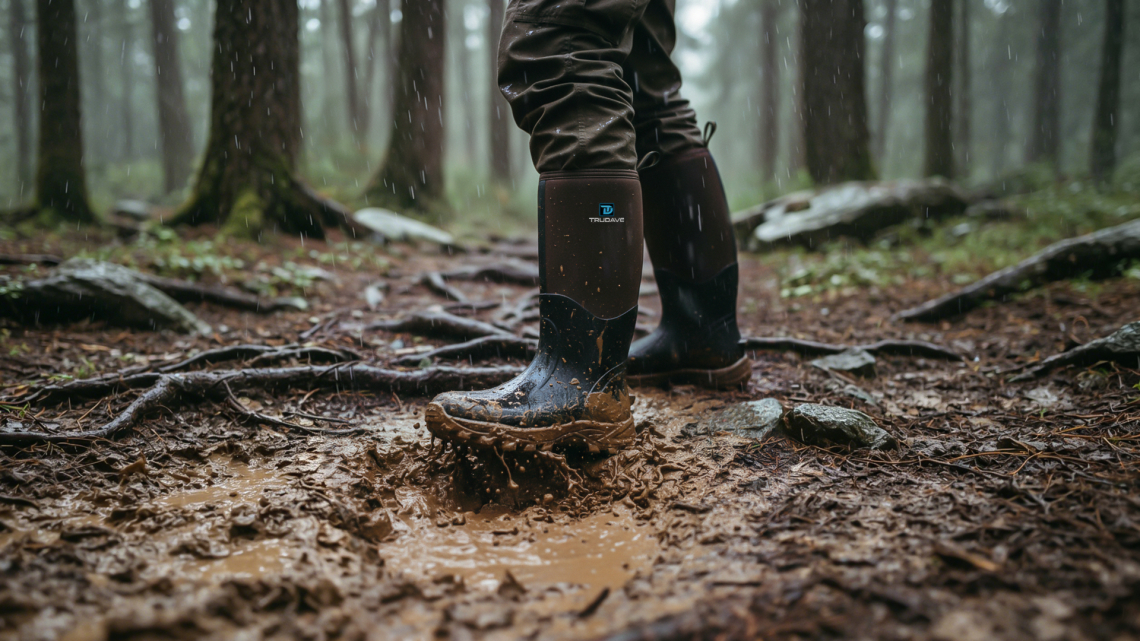
First, the neoprene upper. On the BloomBoot and other neoprene-equipped Trudave models, the shaft is made from the same material used in wetsuits — a closed-cell synthetic rubber foam that flexes, stretches, and conforms to the shape of your calf and ankle. Natural rubber provides a completely waterproof and durable shell, while the flexible neoprene upper offers insulation and comfort, creating a boot optimized for wet and cool conditions. Neoprene is an excellent insulator, trapping body heat to keep you warm in cold water or air, and it is exceptionally flexible and soft, which prevents the chafing and stiffness that can occur with a full rubber boot. Unlike the stiff, unyielding rubber shaft of a traditional rain boot, neoprene gives you that snug, “locked-in” feeling without the laces.
Second, the elastic side gusset. For Trudave’s Chelsea-style models like the GreenStep, elastic side panels allow the boot to stretch during entry and then return to a snug fit around the ankle once you’re in. This is the same technology that has made Chelsea boots a staple of urban fashion for decades, but applied to a boot that can also handle mud, standing water, and garden chores. A pull tab at the heel speeds up entry, and the whole process takes roughly two seconds per foot.
Third, the structured heel cup. On models like the MudTrek and DryFlow, Trudave engineered a heel cup that locks the foot in place once it’s fully seated in the boot. This prevents the “heel slip” that creates friction, and friction creates blisters, and blisters end outdoor work days early. The heel cup is rigid enough to provide stability but designed to work with the flexible neoprene upper rather than against it.
The result of these three elements working together is a fit experience that defies the old stereotypes about slip-on boots. “There’s always a dreaded ‘break-in’ period with hardcore outdoor footwear, where you expect blistered heels and aching arches for the first 20 miles,” Trudave’s product team noted in a recent wear test. “Surprisingly, right out of the box, the flexibility of the upper and the EVA midsole felt completely dialed in.”
This fit architecture also makes the boots compatible with a wider range of sock systems than traditional lace-ups. Trudave’s sizing guidance across their lineup reflects this: if you wear thick work socks, consider sizing up if you are between sizes. The neoprene upper has natural stretch that accommodates different foot volumes, and the slip-on design doesn’t have laces that bottom out when you try to tighten them over a thicker sock. For the gardener who starts the morning in lightweight socks and transitions to thick wool by late fall, this adaptability is a genuine advantage that lace-up boots with fixed volume simply cannot match.
Part 3: The Series Breakdown — Where Each Slip-On Shines
Trudave doesn’t try to build one boot for everyone. Their rain boot lineup is a system of purpose-built slip-ons, each engineered for a specific set of conditions. Here’s how the design philosophy plays out across the lineup.
BloomBoot Series: The Gardener’s Precision Tool
The BloomBoot is the boot for the serious gardener who spends hours kneeling, bending, and working in wet soil and mulch. The 4.5mm neoprene upper bonded to a flexible natural rubber shell means the boot flexes as you walk, bend, kneel, or squat — exactly the movements that define a day in the garden. The mid-calf height shields from splashes without the bulk of tall boots, and the multi-direction grip pattern holds firm on soft soil and grass.
The BloomBoot’s slip-on advantage is most apparent when you’re in and out of the house a dozen times in a single gardening session — grabbing a tool, checking on seedlings, moving between raised beds and the potting bench. A lace-up boot would have you sitting down and unlacing for every transition. The BloomBoot’s slip-on design with a reinforced heel kick-off tab means you’re in and out in seconds without ever touching the boot with your hands.
MudTrek Series: The Everyday Warrior
MudTrek is built for the woman who needs a dependable, no-nonsense pair of rubber rain boots that work in the city, the suburbs, and the yard. The full rubber construction creates a sealed barrier against water — puddles in the driveway, wet parking lots, shallow mud. The mid-calf height hits the sweet spot: taller than ankle boots so splashes don’t soak your pants legs, but not as heavy or bulky as knee-high boots.
The slip-resistant outsole provides extra confidence on wet pavement, tile entries, or wooden decks after a storm. And the slip-on design means the boots live by the door, ready to go for dog walks, trash runs, and rainy errands that don’t justify a full gear-up sequence.
HeatHold Series: Cold-Weather Slip-On Performance
When the temperature drops and standard rain boots turn into iceboxes, the HeatHold Series proves that a slip-on boot can deliver serious cold-weather performance. Built with 6mm insulated neoprene and a tall rubber shell, the HeatHold features deep, multi-directional lugs and self-cleaning channels that maintain grip on wet grass and muddy ground without buildup.
The slip-on design here includes a reinforced heel kick-off ledge with a rear pull loop — because removing frozen, mud-caked boots at the end of a long winter chore day shouldn’t require bending over and wrestling with frozen laces. One Amazon reviewer who tested HeatHold-equivalent Trudave boots put it bluntly: “The money you shell out for these is worth it. They warm in the cold days and cool in the warm days — don’t know how it’s done but I’m ok with it.” Five years of hard use through woods, mud, and around a homestead, and the boots still look new. That’s the durability standard that the slip-on revolution is built on.
MudFlex Series: The Grab-and-Go Hybrid
Not every wet task demands full-height protection. The MudFlex is a mid-ankle slip-on that bridges the gap between a full work boot and a casual waterproof shoe. A durable rubber lower shell combined with a flexible 4.5mm neoprene upper means you can squat, kneel, and bend without the boot cutting into your leg. Integrated grab handles at the top make pulling them on effortless, and the kick-off heel plate lets you remove them without bending over.
GardenStride Series: The Heavy-Duty Problem Solver
The GardenStride is Trudave’s answer to deep mud, manure, and standing water. As their product guidance states: “If your day involves deep mud, manure, or standing water, you need a seal, not a sieve. The high-top design ensures no debris sneaks over the collar.” When the job is done, you just hose them off. No laces to scrub. No eyelets to pick mud out of. No tongue to trap debris. The GardenStride’s slip-on design isn’t a convenience feature — it’s a direct functional response to the conditions it’s built for.
GreenStep Series: The Back-Door Essential
GreenStep fills the lightest slot in the Trudave lineup — a slip-on garden shoe for the quick trips that don’t justify full boots. Taking out the trash, watering the tomatoes, checking the mail. As Trudave frames it: “Every household needs a pair of ‘back door shoes.’ They are durable enough to handle a shovel but easy enough to kick off before you walk on the carpet.” This is slip-on design at its most essential: the boot that lives by the door and gets worn because it’s easy, not because it’s required.
Part 4: How Slip-On Traction Keeps Pace with Lace-Ups
One of the lingering objections to slip-on boots is that they can’t match the traction of lace-ups, especially on uneven or slippery terrain. The logic goes: if the boot isn’t cinched tight around your foot, your foot can move inside the boot, and that internal movement reduces your ability to transfer force to the ground effectively.
Trudave addresses this in two ways. First, the structured heel cup and conforming neoprene upper work together to minimize internal foot movement — the fit is snug enough that the boot and foot move as a unit, which is the same principle that makes a well-fitted lace-up boot effective. Second, the outsole designs are borrowed from Trudave’s hunting boot lineup, where traction is literally a life-or-death feature.
The GardenStride series features deep, open lugs that are “ideal for mud, snow, and loose dirt.” The open channels allow mud to fall out as you walk — what Trudave calls “self-cleaning” — so you don’t lose traction as debris builds up underfoot. The BloomBoot uses a multi-directional tread pattern with siping that grips wet grass and soft soil. The MudTrek’s slip-resistant outsole is optimized for mixed surfaces including pavement, tile, and packed gravel. These aren’t afterthought tread patterns applied to a generic boot — they’re purpose-designed outsoles matched to the specific surfaces each boot is expected to encounter.
For the tasks that slip-on rain boots are designed to handle — gardening, yard work, farm chores, dog walking, rainy commutes — this traction architecture is more than adequate. If you’re climbing a sheer rock face in a downpour, you want mountaineering boots with laces. If you’re weeding the raised beds or walking a wet dog, a slip-on with purpose-built traction is exactly the right tool.
Part 5: The Sizing Framework — Getting the Slip-On Fit Right
The most common sizing mistake with slip-on boots is ordering too small. The logic is understandable: without laces to tighten, buyers assume the boot needs to fit snugly out of the box. But Trudave builds intentional volume into their slip-on boots for the same reason their hunting boots run slightly large: to accommodate the thick socks that outdoor workers actually wear.
Across multiple Trustpilot reviews, the pattern is consistent. One reviewer captures it precisely: “Bought some boots from Trudave. These boots are well made and comfortable. The size is slightly larger, but with socks they fit well and comfortably. A size smaller would be too tight.” That last sentence is the key takeaway. The intentional room isn’t a sizing error — it’s designed to be filled by the sock system. Eliminate that room by sizing down, and the boot becomes too tight with the socks you’ll actually wear in the field.
Another user on Trustpilot offers a practical confirmation: “I sized up because I want to be able to wear thick handmade socks in the fall and winter. They fit beautifully.” The neoprene upper on models like BloomBoot provides natural flexibility that adapts to different foot volumes, so sizing up for thick socks doesn’t result in a loose, sloppy fit — it results in the fit the boot was designed to deliver.
The practical framework: if you plan to wear thick wool socks (for gardening in cool weather or farm chores in the cold), order your standard size. The slip-on design will feel generous with thin socks but correct with the thick socks it was designed around. If you’re between sizes, size up for heavy socks, size down for light socks. If you have narrow feet, a thicker sock or an additional insole takes up the intentional volume without affecting the boot’s length.
Part 6: Care for Slip-Ons — Simpler by Design
One of the quiet advantages of slip-on construction is that it’s simply easier to maintain. Fewer components mean fewer failure points. No laces to replace. No eyelets to corrode. No tongue to trap debris and moisture.
Trudave’s recommended care protocol is the same across the lineup: rinse with clean water after use, wipe off dirt with mild soap, air dry naturally away from direct sunlight or heat. The slip-on design makes this routine faster — there are no laces to clean around, no crevices where mud hides, no hardware that needs to be dried to prevent rust.
For neoprene-equipped models like the BloomBoot and HeatHold, the additional consideration is that neoprene can retain odors if stored damp. After a long day in the garden or the paddock, pulling the insoles out (if removable) and allowing the interior to air dry completely prevents the musty buildup that eventually makes any boot unpleasant to wear. Crumbled newspaper stuffed inside overnight is an old gardener’s trick that works as well as anything: it wicks moisture from the neoprene lining while the boot dries from the outside in.
Part 7: The Decision Framework — Which Trudave Slip-On Is Yours?
By now, the philosophy should be clear: the right boot for you depends on matching the materials and design features to what you actually do. Here’s the framework.
Choose BloomBoot if: You’re a dedicated gardener who spends hours kneeling and bending in wet soil. You need the flexibility of a 4.5mm neoprene upper that moves with you rather than fighting against you, and you value breathable comfort for long sessions.
Choose MudTrek if: You need a reliable everyday rain boot for dog walks, errands, commutes, and light outdoor work. Full rubber waterproofing, slip-resistant traction on wet pavement, and a mid-calf height that protects without weighing you down.
Choose HeatHold if: Your main battle is with cold. Freezing temperatures, snow, icy slush, winter chores. You need 6mm insulated neoprene that keeps feet warm through long, still hours outdoors, plus a tall waterproof shell and self-cleaning traction for frozen ground.
Choose MudFlex if: You want a grab-and-go hybrid for quick trips outside, light chores, and everyday wet-weather convenience. Easy on, easy off, flexible enough for squatting and kneeling.
Choose GardenStride if: Your days involve deep mud, manure, or standing water. You need a sealed, high-top design that keeps debris out and rinses clean in seconds. The heavy-duty option for heavy-duty work.
Choose GreenStep if: You need a “back door shoe” — something waterproof and durable enough for quick outdoor tasks but easy enough to kick off before you walk on the carpet. The grab-and-go essential.
Get two (or three) if: Your work spans multiple seasons and conditions. A BloomBoot for the growing season, a HeatHold for winter, and a MudTrek for everything in between. At Trudave’s direct-to-consumer pricing, owning the right slip-on for each job costs less than a single pair of premium-brand lace-up boots from legacy manufacturers.
Conclusion: The Boots That Don’t Make You Choose
The outdoor gear industry has spent decades telling consumers that they have to choose: convenience or performance. Speed or stability. Easy on or secure fit. The slip-on revolution that Trudave Gear is advancing rejects that binary entirely.
Modern materials — neoprene that flexes and conforms without losing insulation value, natural rubber that seals out water without stiffening into an unforgiving shell, EVA midsoles that cushion without collapsing — have closed the performance gap between slip-on and lace-up designs. What remains is a difference in philosophy. Do you want a boot that requires you to stop and tie it, or a boot that lets you step in and go?
For the gardener, the farmer, the dog walker, the commuter, and the homesteader, the answer increasingly tilts toward the boot by the door. Not because it’s lazy, but because it’s smart. Because the five minutes you save not lacing up in the freezing cold is five more minutes outside, doing the thing you’re out there to do. Because the mud that doesn’t get trapped in laces and eyelets is mud that doesn’t end up on your kitchen floor. Because a boot that’s easy to put on is a boot that actually gets worn, and a boot that gets worn is worth infinitely more than a boot that sits in the closet because the thought of lacing up is just one barrier too many.
The Trudave rain boot lineup — BloomBoot, MudTrek, HeatHold, MudFlex, GardenStride, and GreenStep — is built on a simple premise: the boot that works is the boot you reach for. And the boot you reach for is the one that makes your life easier, not harder. Slip on. Step out. Get to work. That’s the revolution.
To explore the complete Trudave Gear rain boot lineup and find the right slip-on for your garden, farm, or everyday life, visit trudavegear.com.


You May Also Like
How to Transition Your Grazing Plan as Summer Comes to an End
Spring Mulching Tips That Keep Weeds at Bay Before Summer