Beyond the Puddle: The Complete 2026 Trudave Rain Boot Guide for Heavy-Duty Farming and Mud Season
Heavy-duty farming creates boot demands that casual gardening never does—suction mud, corrosive manure, extreme fatigue, and freezing mornings. Here is the complete Trudave Tall Rain Boot guide for serious agricultural workers.
Farming in extreme wet conditions is a different discipline.
The property is the same. The chores are the same, and often significantly more urgent. The equipment is largely the same. But the environment around all of that is completely different from dry-season farming in ways that affect every piece of your gear—especially your boots.
Farmers who manage livestock or large acreages year-round understand the specific challenges that torrential rain and thawing frost add: navigation hazards that dry ground makes routine and deep mud makes treacherous, corrosive barnyard environments that eat cheap plastics alive, the accumulated fatigue of 14-hour days in heavy footwear, and the particular logistics of moving from the muddy pasture to the tractor cab.
Boots are part of this equation in ways that most standard “rain boot” content completely ignores. The boot that serves you well for a quick trip to the mailbox may not be the right boot for a 4 a.m. dairy parlor shift, a muddy spring fencing project, or a freezing morning feeding cattle. This guide addresses the specific demands of heavy-duty farming—by chore, by season, by the specific conditions that extreme farm weather creates—and maps the Trudave Tall Rain Boot to each scenario.
Why Heavy-Duty Farming Changes Your Boot Requirements
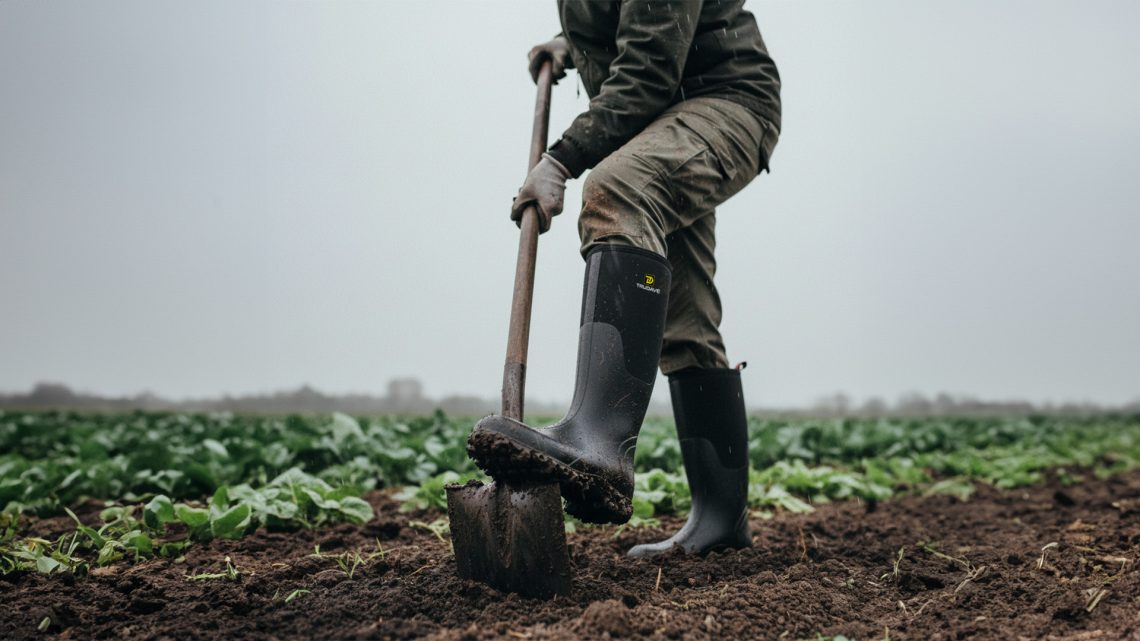
Challenge 1: Terrain Navigation in Suction Mud The pasture gate at late-March thaw looks different from the same gate in July—not because the layout has changed, but because the freezing and thawing cycle has created “suction mud.” You’re navigating boot-stealing clay, deep tractor ruts, and slippery grass inclines while carrying 50-pound feed bags. This changes the fit requirement in a specific way: standard loose-fitting rubber boots will pop right off your heel when the mud creates a vacuum. Heavy-duty farm work requires a boot with advanced heel-lock engineering to ensure the footwear stays attached to your body, no matter how deep the muck gets.
Challenge 2: Corrosive Barnyard Environments Farm water isn’t just water. It’s often a mixture of agricultural chemicals, fertilizer runoff, and highly acidic livestock manure. These elements affect boot lifespan in ways that suburban gardening doesn’t. A cheap PVC boot that looks waterproof may begin to rot, crack, and degrade at the flex points within weeks of exposure to chicken or cow manure. The boot that protects you in these environments must be chemically resistant and built from genuine vulcanized rubber, not discount plastics.
Challenge 3: Accumulated Fatigue Over 14-Hour Days Farming sessions are typically longer and more physically punishing than almost any other outdoor profession. The nature of the job involves lifting, stomping on shovels, climbing steel tractor ladders, and standing on unforgiving concrete slabs. Ten hours of active farming produces immense accumulated foot and lower back fatigue. Boot cushioning, arch support (specifically rigid shanks for shovel work), and the ability to maintain structural integrity under heavy loads matter far more for agriculture than for typical outdoor recreation.
Challenge 4: Visibility, Safety, and Gear Management Farm chores involve managing heavy equipment in the dark—hooking up implements before sunrise, unlatching heavy steel gates, and avoiding the hooves of nervous livestock. In this environment, boot protection and ease of removal become significant. At 8 p.m., after a grueling day in the freezing mud, fumbling with laces or trying to yank off a suctioned rubber boot with your bare, cold hands is a real frustration. Boots that kick off easily via a hands-free heel ledge are the correct specification for the farm mudroom reality.
Farm Scenario 1: The Dairy Parlor & Livestock Barn (Concrete and Manure)
What This Looks Like You’re in the milking parlor or horse barn from 4 a.m. to 9 a.m. The floor is smooth concrete. The environment is continuously wet from high-pressure washdown hoses, urine, and manure. You are standing in one place for extended periods, then walking quickly across slick surfaces.
Boot Demands
- Maximum chemical and acid resistance against concentrated livestock waste.
- Aggressive, siped or micro-channeled traction that holds on smooth, wet concrete (similar to a boat deck, but with biological hazards).
- Thick midsole cushioning to prevent the lower back pain associated with standing on concrete for 5+ hours.
- Easy to hose down completely without water seeping through seams.
The Right Choice: Trudave Tall Rain Boots The Trudave Tall Rain Boots pair a multi-layered, vulcanized rubber shell that acts as armor against barnyard acids. The aggressive tread pattern is designed to push waste and water out from under the foot, ensuring you don’t slip while handling large animals. For the dairy farmer or ranch hand, the thick EVA footbed is the difference between waking up sore and waking up ready to work.
Barn hygiene tip: Keep a stiff-bristled brush right next to the washdown hose. The smooth exterior of the Trudave boot allows you to blast off 99% of the manure in seconds, preventing corrosive materials from sitting on the rubber overnight in the tack room.
Farm Scenario 2: Spring Fencing & Pasture Thaw (Deep Mud and Brush)
What This Looks Like It’s April. You need to walk the perimeter fence line after a winter storm. You’re navigating uneven terrain, crossing flooded creek beds, kicking through thorny underbrush, and dealing with knee-deep “boot-sucking” mud. You are carrying heavy tools, post drivers, and rolls of barbed wire.
Boot Demands
- 100% waterproof protection up to the upper calf (15-16 inches) for creek crossings.
- Heel-lock internal design to prevent the boot from being sucked off in deep clay.
- Reinforced toe and shin guards to deflect thorns, briars, and accidental tool strikes.
- Rigid arch support for stomping down fence posts or kicking shovels into the dirt.
The Right Choice: Trudave Tall Rain Boots For open pasture navigation during mud season, the Trudave Tall Boot’s anatomical fit is crucial. The boot tapers slightly at the ankle, locking your heel in place when you pull your foot out of a mud rut. The upper shaft provides a 15-inch impenetrable barrier against wet grass, ticks, and briars.
Fencing terrain strategy: When walking miles of uneven pasture, foot friction causes blisters. Wear a moisture-wicking liner sock under a medium-weight wool sock inside your Trudave boots. This creates a slip-plane that absorbs the friction of walking off-camber on hillsides, extending your operational range.
Farm Scenario 3: Deep Winter Feeding (Freezing Temps & Slush)
What This Looks Like It’s 15°F in late January. You have to break the ice on the water troughs and throw hay from the back of the pickup. You are stepping in a mixture of frozen mud, sharp ice shards, and freezing slush.
Boot Demands
- Rubber compounds that remain flexible in sub-freezing temperatures (cheap PVC cracks in the cold).
- Thermal barrier protection against freezing ground temperatures.
- Traction that can bite into frozen mud and snowpack.
- Slightly wider fit to accommodate heavyweight thermal socks.
The Right Choice: Trudave Tall Rain Boots (Sized up for Winter) While not a dedicated pac-boot, the Trudave Tall Rain Boot is heavily utilized by winter farmers when sized correctly. The vulcanized rubber remains pliable well below freezing, preventing the catastrophic “flex-crack” across the top of the foot. Temperature transition strategy: Buy your Trudave rain boots a half-size larger if you farm in the North. Pair them with a 800-weight merino wool sock and an insulated foil-bottom insole. The 100% windproof/waterproof rubber shell traps the heat generated by your foot, making them highly effective for active winter chores.
Farm Boot Features Ranked by Importance
Understanding which features matter most for heavy agriculture helps prioritize the selection:
- Chemical/Acid Durability (Critical): The ability to withstand manure and fertilizers without rotting is the defining line between a “farm boot” and a “garden boot.”
- Heel-Lock & Ankle Fit (Critical): Farm mud will steal a loose boot. Anatomical shaping around the ankle keeps you moving securely.
- Hands-Free Removal (High): The “kick rim” or heel ledge is mandatory. Removing boots without touching them with dirty, cold hands prevents cross-contamination into your home.
- All-Session Cushioning (High): 14-hour days on concrete or hardpan dirt require shock absorption. Flat soles destroy knees.
- Puncture Resistance (Moderate): Reinforced toe boxes and heel counters protect against sharp rocks, barbed wire, and tools.
Farm Boot Maintenance: The Mudroom Care Routine
Farming produces severe boot contamination. The pre-house wash protocol for farmers: Before stepping into the mudroom, utilize a boot scraper and an outdoor hose. The two minutes of rinsing prevents dried, hardened clay that degrades the rubber’s flexibility. Drying protocol: Never place your rubber farm boots directly next to a roaring wood stove or space heater to dry the insides. Extreme, localized heat bakes the natural rubber, causing premature dry rot. Use a low-heat forced-air boot dryer to manage interior sweat.


You May Also Like
One Rain Boot, Four Jobs: Why the “Versatile” Boot Is Often the Worst Choice

Why Root Systems Become the Weakest Link in Summer Gardens