Rubber vs. Neoprene — The Science Behind Trudave Gear’s Rain Boot Materials (And Why It Matters When You’re Standing in a Puddle)
Every pair of wet socks has a story. Mine came on a Tuesday morning in late March, standing in my driveway while a slushy mix of half-melted snow and rain crept over the top of what I’d been told were “waterproof” boots. The boots themselves hadn’t leaked — the seams had held, the rubber was intact — but my feet were freezing. Not wet from the outside. Wet from the inside. My own sweat, trapped against my skin by a material that kept water out with the same enthusiasm it kept moisture in.
That morning set me on a research path I hadn’t expected to travel. I started reading about boot materials — not marketing copy, but actual materials science. Vulcanization. Neoprene cell structure. Thermal conductivity coefficients. The kind of stuff that makes your eyes glaze over until you realize it explains exactly why your feet were miserable at 7 AM on a Tuesday.
What I discovered changed how I think about rain boots entirely. The difference between a boot that keeps you comfortable and one that doesn’t isn’t about brand names or price tags — it’s about material choice. And the two materials that dominate the modern rain boot market, rubber and neoprene, behave in fundamentally different ways that most buyers never consider.
Trudave Gear has built their entire rain boot lineup around understanding this material science. Instead of defaulting to one material and building everything around it, they’ve matched specific material combinations to specific use cases: neoprene where insulation and flexibility matter, rubber where durability and simplicity rule, and bonded neoprene-rubber construction where the best of both worlds is required. This article is about why that matters — the actual physics and chemistry that determine whether your feet stay warm, dry, and comfortable when the weather turns.
Part 1: The Material Science — What’s Actually Happening Inside Your Boot
Let’s start with a fundamental truth that most rain boot marketing glosses over: “waterproof” is the easy part. A plastic bag is waterproof. A trash can is waterproof. What makes a boot worth buying isn’t whether it keeps water out in ideal conditions — it’s how it performs across the full range of conditions you’ll actually encounter. Temperature swings. Physical flexing. Extended wear. Abrasion against rocks, concrete, and gravel. And here’s where material choice becomes everything.
Rubber: The Old-School Workhorse (With a Modern Upgrade)
Natural rubber has been keeping feet dry for over a century, and for good reason. When properly vulcanized — a chemical process that uses sulfur and heat to cross-link rubber polymers into a stable, elastic network — natural rubber creates an impermeable barrier that water simply cannot penetrate. Unlike fabric boots that rely on coatings or membranes, a solid rubber shell doesn’t have pores to clog, membranes to crack, or DWR treatments to wear off. Water hits it, and water stops.
But rubber has trade-offs that anyone who’s worn cheap rain boots knows intimately. Traditional rubber is stiff. It doesn’t insulate — in fact, it conducts heat away from your foot faster than most materials, which is why standing in cold water in pure rubber boots makes your feet cold within minutes even if they stay technically dry. Rubber also doesn’t breathe at all, which means any moisture generated inside the boot — and your feet produce roughly half a pint of sweat per day — stays trapped inside.
The quality of the rubber matters enormously. Cheap rubber boots often use PVC (polyvinyl chloride) instead of natural rubber, which is stiffer, more brittle, and prone to cracking at flex points within a single season. As Trudave notes in their materials guidance: “Most generic rain boots fail in three areas: The Material (Too Stiff): Cheap boots are often made of rigid PVC plastic, not high-grade rubber. They don’t flex with your foot … It’s usually just a flat piece of rubber. No arch support, no shock absorption.”
Natural rubber, by contrast, offers inherent flexibility that PVC cannot match. It bends with your foot rather than fighting against it, which reduces fatigue during long wear and prevents the cracking at flex points that eventually kills cheap boots. This is why Trudave builds their rain boot shells from premium natural rubber rather than petroleum-based PVC — the material cost is higher, but the durability and comfort difference becomes obvious within the first week of real use.
Neoprene: The Insulating, Flexible Disruptor
Neoprene entered the footwear world from an unlikely source: wetsuits. The same material that keeps divers warm in cold water turns out to be exceptionally well-suited for boots that need to handle cold, wet conditions. And the science behind why is genuinely elegant.
Neoprene is a synthetic rubber — specifically, polychloroprene — that’s manufactured as a foam. Those tiny air bubbles trapped in the foam structure are what give neoprene its defining characteristic: insulation. Unlike solid rubber, which conducts heat efficiently (bad for keeping feet warm), neoprene traps body heat in millions of microscopic air pockets, creating a thermal barrier between your foot and the cold ground or water outside the boot.
This insulation property isn’t just about comfort — it changes how you can use the boot. A pure rubber boot in 35-degree water will have your feet cold within 15-20 minutes regardless of sock choice, because the cold conducts straight through the rubber. A neoprene-lined boot in the same conditions keeps your feet warm significantly longer because the neoprene breaks that thermal bridge.
Neoprene boots are flexible, lightweight, and offer better insulation, making them ideal for cold water conditions, while rubber boots dominate with superior waterproofing and durability in muddy or rainy trails. This distinction is crucial: neither material is universally “better.” They’re better at different things. Rubber gives you rugged all-weather tough protection, while neoprene kicks in with better insulation and flexibility, making your feet feel less like they’re strapped in a damp tank.
The trade-off with neoprene is breathability. Because rubber and neoprene create a waterproof seal to keep water out, they also trap moisture and sweat inside. This is manageable in cold weather (where your feet sweat less) but can become noticeable during high-output activity in warm conditions. Neoprene, while not fully breathable, does offer better ventilation compared to traditional rubber, making neoprene boots a suitable option for activities where you might experience varying temperatures and movement.
The Bonded Construction: Why Trudave Uses Both
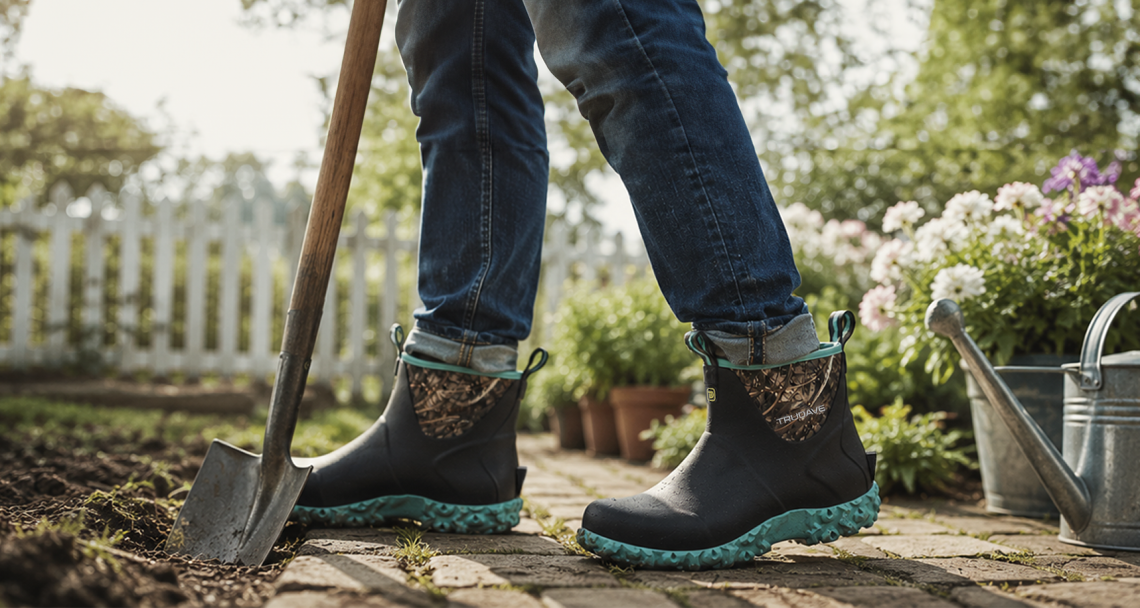
Here’s where Trudave’s design philosophy departs from the industry standard. Instead of choosing one material and building entire boots from it, they use a bonded construction: a natural rubber lower shell for waterproof integrity and durability, bonded to a neoprene upper shaft for insulation, flexibility, and calf comfort.
This isn’t two pieces glued together — it’s a vulcanized bond, where the rubber and neoprene are chemically fused at a molecular level. The result is a single continuous waterproof barrier that can’t delaminate at the seam (the most common failure point in multi-material boots). The rubber handles the hard work of abrasion resistance, ground-level waterproofing, and structural durability. The neoprene handles insulation, ankle flexibility, and calf comfort.


You May Also Like

Low-Temp Calving Prep: Setting Up Warm Zones Before a Surprise Birth

Building Compost Piles: Turning Fall Waste Into Spring Fertility