The Warmth Equation — Why Some Boots Feel Colder Than Others (Even When They’re Both “Waterproof”)
Here’s a scenario every cold-weather gardener or farmer knows: two pairs of boots, both “100% waterproof.” Standing in the same 40-degree mud. One pair leaves your feet warm all morning. The other has you stomping your toes by 9 AM to keep circulation going. Both are technically dry inside. So what’s different?
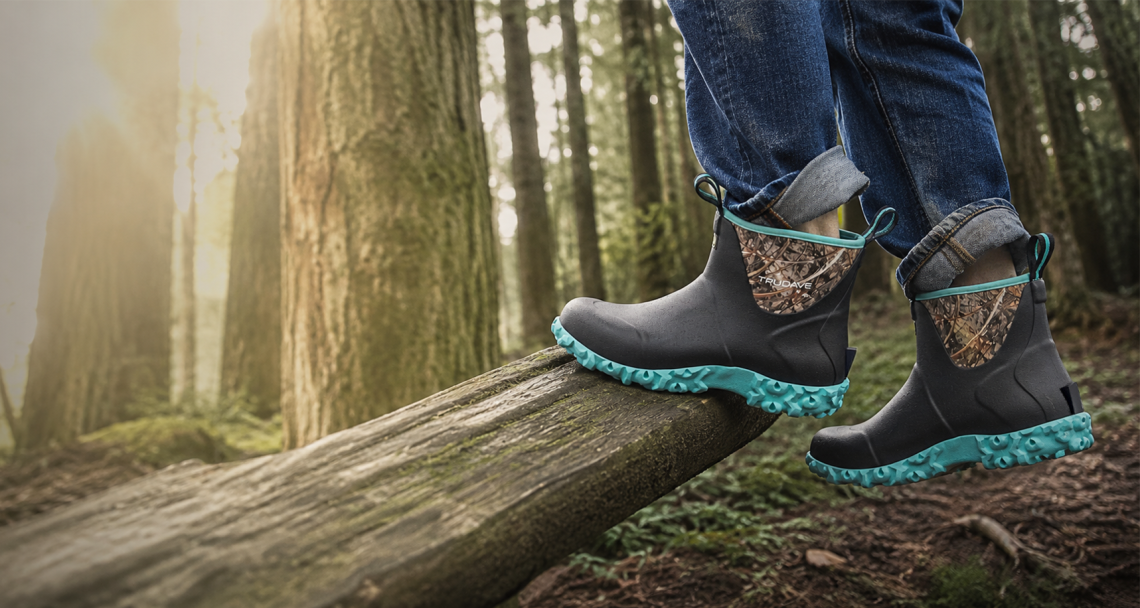
The answer is thermal conductivity — how efficiently a material transfers heat from your foot to the cold ground. Pure rubber has high thermal conductivity; it’s essentially a heat sink. Neoprene, with its foam-cell structure, has low thermal conductivity; it’s a heat trap. This is why Trudave’s insulated boots, like the HeatHold Series, use neoprene as the primary insulation layer rather than relying on thicker socks or removable liners to do the job.
The HeatHold Series women’s boots are 100% waterproof and feature 5mm insulated neoprene lining that keeps your feet warm, dry, and comfortable in rain, snow, or muddy garden conditions. The neoprene shaft changes the game: it’s a robust insulating layer bonded to a durable rubber shell that traps warmth while remaining breathable, delivering cozy comfort without overheating.
But here’s what’s interesting: even uninsulated neoprene-rubber boots provide noticeably more warmth than pure rubber boots, simply because the neoprene shaft breaks the thermal bridge that pure rubber creates between your calf and the cold air. This is why the BloomBoot Series, built with a 4.5mm neoprene upper, keeps feet warmer during cool-weather gardening than a pure rubber boot of equivalent height — not because it has active insulation, but because it doesn’t actively pull heat away from your foot the way solid rubber does.
Part 3: The Traction Science — Siping, Lugs, and Why Deep Tread Isn’t Always Better
Traction is the second pillar of rain boot performance, and it’s another area where material science intersects with design in ways that aren’t obvious from looking at a product photo.
Deep, aggressive lugs work beautifully in mud and soft soil — they bite into the ground and provide mechanical grip. But on hard, wet surfaces like pavement, tile, or packed gravel, deep lugs can actually reduce traction because they minimize the rubber-to-ground contact patch. A boot with huge mud lugs on a wet concrete floor is essentially balancing on the tips of its tread blocks.
This is why siping matters. Siping is the process of cutting thousands of tiny slits into the rubber outsole, creating edges that act like miniature squeegees — they channel water away from the contact surface and create multiple biting edges that grip hard, wet surfaces. It’s the same technology that makes winter tires grip ice, applied to boot soles. Trudave’s multi-directional lugs and self-cleaning channels help maintain grip on wet grass and muddy ground without buildup.
The BloomBoot Series features a non-slip rubber outsole that provides excellent grip on slippery, muddy, or wet ground — perfect for working in the garden, yard, or running rainy-day errands. The multi-directional grip pattern holds firm on soft soil and wet grass, while the rubber shell resists scratches and abrasions from garden tools and rough ground.
For more demanding traction needs, the AquaGrip Series takes a different approach entirely: a signature suction-pod outsole that grips confidently on algae-covered rocks and muddy banks, giving you the traction needed to move freely in environments where standard lug patterns would slip. This is targeted traction design — matching the outsole pattern to the specific surface type it needs to handle — rather than assuming one tread pattern works everywhere.
Part 4: The Comfort Infrastructure — Insoles, Shanks, and Why Your Arches Hurt
Most people think about boot comfort in terms of “cushioning,” but the reality is more structural. Your foot is an arch — a complex biomechanical structure that needs support, not just padding. A soft, squishy boot with no arch support feels comfortable for about 20 minutes, then your plantar fascia starts screaming.
Trudave builds structural support into their rain boots through several mechanisms. The cushioned EVA insoles provide shock absorption without being so soft that they collapse under sustained weight. The breathable inner lining manages moisture to prevent the clammy sensation that makes feet feel uncomfortable even when they’re technically dry. And in select models, a steel shank provides torsional rigidity — resistance to twisting — that protects your arches when you’re walking on uneven ground.
The importance of a steel shank is easy to overlook until you’ve spent a day walking on a rocky shoreline or an uneven pasture without one. Without torsional support, every uneven step forces your foot to twist to match the ground angle, and your plantar fascia absorbs that torque. Multiply that by 10,000 steps, and you understand why arch support isn’t a luxury feature.
Trudave’s 6mm neoprene rubber rain boots provide exceptional all-day comfort, often compared to slippers or tennis shoes, with guaranteed 100% waterproofing and effective 6mm neoprene insulation. Users confirm these boots are “waterproof as advertised” and keep feet “warm and dry,” with traction described as “on par with snow tires”.
Part 5: Choosing by Material — A Decision Framework
By now the pattern should be clear: material choice drives performance. The best boot for you depends on matching the material properties to your actual conditions, not on which boot has the highest price tag or the most aggressive marketing. Here’s the framework:
| Your Conditions | Material Priority | Trudave Match | Key Material Feature |
|---|---|---|---|
| Cool-weather gardening, damp soil, kneeling | Neoprene flexibility + light insulation | BloomBoot (4.5mm neoprene) | Flexible shaft won’t dig into calf when kneeling |
| Cold-weather chores, freezing mud, snow | Maximum neoprene insulation | HeatHold (5mm insulated neoprene) | Thermal barrier for stationary work in cold |
| Wet grass, pavement, light mud, everyday wear | Pure rubber simplicity | MudTrek (100% rubber) | Sealed barrier, easy rinse, no-fuss durability |
| Slick rocks, algae, riverbeds, boat launches | Targeted traction outsole | AquaGrip (suction-pod rubber) | Surface-specific grip pattern for wet rock |
| Heavy outdoor work, construction, farming | Industrial rubber + structural support | AquaGuard / HuntGuard (industrial-grade rubber) | Reinforced shell, deep-lug stability |
If you’re working in mud and rain but not freezing cold, pure rubber boots like the MudTrek offer the simplest, most durable solution. If you’re gardening or farming in cool-to-cold conditions where you’re kneeling and bending, neoprene flexibility becomes a priority. If you’re standing in freezing mud or snow for extended periods, insulated neoprene like the HeatHold is non-negotiable.
Part 6: Care by Material — How to Make Your Boots Last
Material choice also dictates care requirements. The three enemies of any rain boot are UV exposure (sunlight breaks down rubber polymers), heat (accelerates degradation and can cause delamination), and salt (crystalizes in microscopic surface pores and creates stress points that become cracks).
Trudave’s recommended care routine is consistent across their lineup: rinse with clean water after each use, wipe away dirt with mild soap, and air dry naturally away from direct sunlight or heat sources to maintain the rubber flexibility and waterproof seal.
For neoprene-lined boots specifically, there’s an additional consideration: neoprene can retain odors from sweat if not allowed to fully dry between uses. After a long day in neoprene boots, pull the insoles out if they’re removable, and store the boots upright in a well-ventilated area rather than in a closed mudroom cabinet. This prevents the musty buildup that eventually makes any boot unpleasant to wear.
A note on the white, chalky film that sometimes appears on rubber boots: this is called “bloom.” It’s the natural waxes and oils in rubber rising to the surface — cosmetic, not structural. A wipe-down with a damp cloth and mild soap restores the finish. Bloom doesn’t mean your boots are degrading; if anything, it means the rubber still has plasticizers in it, which is a good thing for long-term flexibility.
The Bottom Line: Material Literacy Beats Brand Loyalty
The outdoor gear industry runs on brand loyalty. People buy the same boots their dad wore, or the ones their favorite guide swears by, or the ones with the biggest marketing budget. But loyalty to a brand name doesn’t keep your feet warm. Material choice does.
Trudave Gear’s approach — matching neoprene, rubber, or bonded construction to specific use cases rather than defaulting to one material — reflects a deeper understanding of how boots actually perform in the field. The BloomBoot uses 4.5mm neoprene because gardeners kneel. The HeatHold uses 5mm insulated neoprene because cold-weather chores mean standing still in freezing mud. The MudTrek uses full rubber because sometimes you just need a waterproof shell that rinses clean and gets back to work.
Understanding why these choices matter — the thermal conductivity, the flexibility dynamics, the traction science — transforms how you shop for boots. You stop looking at brand names and start looking at materials. You stop asking “is this a good boot?” and start asking “is this the right boot for what I’m actually going to do in it?” That’s the difference between buying boots that keep you dry and buying boots that keep you comfortable — and in the real world of wet mornings and muddy chores, those aren’t the same thing.
Title: Real People, Real Mud — What Trudave Gear Rain Boot Owners Are Saying After Months of Hard Use (2026 Edition)
Introduction: The Difference Between a Review and the Truth
I have a problem with most product reviews: they’re written after a week of use, sometimes less. The boots are still fresh. The rubber hasn’t been tested by freeze-thaw cycles. The insoles haven’t had time to compress or hold their shape. The waterproofing hasn’t faced the slow, grinding test of a full season of mud, manure, and morning dew.
Real durability data doesn’t come from unboxing videos. It comes from the gardener in Vermont who’s worn the same pair through two springs of wet clay soil. From the farmhand in Kentucky who’s stood in freezing mud at 5 AM for an entire winter. From the dog walker in Seattle who’s logged 400 miles of rainy sidewalks and never once had wet socks.
This article is an attempt to gather that real-world intelligence — not from lab tests or spec sheets, but from the people who’ve actually put Trudave Gear rain boots through months of hard, repetitive, unglamorous outdoor work. I’ve combed through Trustpilot reviews, Amazon feedback, independent review sites, and user-submitted testimonials to build a picture of how these boots hold up when the new-boot smell fades and the real work begins.
What emerges is surprisingly consistent: patterns of praise around waterproof integrity, comfort, and value, along with consistent notes about sizing and specific use-case limitations that no marketing page will volunteer. Here’s what the boots look like after the honeymoon ends.
Part 1: The Waterproof Verdict — Does the Seal Hold?
If there’s one question that matters above all others for rain boots, it’s this: do they actually keep water out — not on day one, but after months of flexing, abrasion, and temperature swings? Across multiple review sources, the answer from Trudave users is remarkably consistent.
On Trustpilot, where Trudave maintains a “Great” rating of 4.1 out of 5, users consistently validate the waterproof claims. One reviewer summarizes months of use: “It has been about two months now and these boots are still going strong and keeping our feet protected”. That “two months” detail matters — it’s enough time for glued seams to start separating, for hairline cracks to form at flex points, for the waterproof claims to either hold up or collapse.
Independent review sites have been even more emphatic. One comprehensive review of the 6mm neoprene models confirms: “100% Waterproof — 6mm lightweight neoprene rubber rain boots give you comfort and flexibility” and notes the waterproof claims are “overwhelmingly validated, with users confirming they are ‘waterproof as advertised’ and keep feet ‘warm and dry'”.
An Amazon reviewer who tested the boots in genuinely extreme conditions — an Arctic expedition — reported: “Fit perfectly. Warm in arctic expedition. On and off zodiacs and in water. They are waterproof. Hiked in them and all. These boots were perfect. No sore feet or legs. No blisters”. That’s not a backyard test. That’s standing in freezing saltwater, climbing in and out of inflatable boats, then hiking over uneven terrain — the kind of mixed-use punishment that exposes every weakness a boot has.
The BloomBoot Series, designed for gardeners, earns consistent waterproof validation: “Trudave BloomBoot Series women’s garden boots are completely waterproof, featuring a 4.5mm neoprene upper and rubber shell that keep your feet dry in mud, rain, or wet grass”. Users working in wet soil and morning dew report dry feet through full gardening sessions.
What’s notable across the reviews is the absence of complaints about seam failure — the most common failure mode for waterproof boots. This points to the vulcanized construction doing its job. Seams that are chemically bonded rather than glued don’t separate over time, and Trudave appears to have gotten the bonding process right.
Part 2: The Comfort Report — “Like Slippers” and Other User Descriptions
Comfort is subjective, but patterns in user language reveal real information. When multiple independent reviewers independently use the same unusual comparison, it’s usually because the boot is doing something distinctive.
The most striking pattern in Trudave comfort reviews is the frequency with which users compare the boots to slippers or sneakers — not typical language for rubber rain boots. One detailed independent review noted “Exceptional all-day comfort, often compared to slippers or tennis shoes” as a consistent user-reported strength.
The BloomBoot Series earns specific comfort praise for its garden-specific design: “These mid-calf waterproof boots have cushioned insoles, breathable lining, and flexible construction that allow comfort and movement during long gardening sessions or outdoor chores”. For gardeners who spend hours kneeling and bending, that flexibility at the ankle and calf makes a functional difference.
The AquaGrip Series offers the same comfort architecture for a different audience: “These mid-calf waterproof boots feature cushioned insoles, breathable lining, and flexible construction that provide lasting comfort for all-day farm work or gardening”. The consistency of this design approach — cushioned insoles, breathable lining, flexible construction — across multiple Trudave series suggests it’s not a one-off feature but a core design philosophy.
The HeatHold Series adds thermal comfort to the equation, with users describing “cozy, sock-like comfort without overheating” thanks to the insulated neoprene shaft. This is a harder comfort claim to make — warmth without sweat — and the fact that it shows up in user reviews rather than just product copy suggests the insulation balance works in practice.
Part 3: Sizing Intelligence — The Consistent “Runs Large” Pattern
Here’s where user reviews provide information that product pages won’t. Across multiple Trudave series and review platforms, a consistent sizing pattern emerges: the boots run slightly large by design, and most users recommend ordering down if between sizes.
One Trustpilot reviewer captures the experience precisely: “Bought some boots from Trudave, These boots are well made and comfortable. The size is slightly larger, but with socks they fit well and comfortably. A size smaller would be too tight”. The key detail: sizing down would be “too tight,” meaning the extra room is intentional — designed to accommodate the thick socks that outdoor workers and cold-weather users actually wear.
The Arctic expedition reviewer adds a data point: “I am a size 9- 9.5 in woman’s and the size 8 boot was perfect”. That’s a full size to size-and-a-half down, and the boots still fit “perfectly” — further evidence that Trudave’s sizing runs large.
The practical takeaway: order your standard size if you plan to wear thick wool socks. If you’re between sizes, size down. If you plan to wear thin socks in warm weather, consider sizing down a full size. The neoprene upper on most Trudave rain boots offers natural stretch that accommodates the foot and calf, so a slightly smaller size won’t feel restrictive the way it might with pure rubber boots.
Part 4: Use-Case Insights — Where Users Say These Boots Shine (and Where They Don’t)
User reviews reveal not just what the boots do well, but what specific activities they’re being used for — and where users sometimes reach for something different.
Gardening and Yard Work: The BloomBoot Series is the consistent favorite for serious gardeners. “Ideal for gardening, yard work, or farm chores,” with users emphasizing the flexible neoprene upper that doesn’t dig into the calf during kneeling. The mid-calf height shields from splashes without the bulk of tall boots, and the easy-rinse surface means transitioning from garden to indoors without tracking mud.
Farming and Heavy-Duty Chores: Users working in farm environments gravitate toward the MudTrek and AquaGuard Series for their full rubber construction and industrial-grade durability. The AquaGuard is “crafted from industrial-grade rubber that seals out water and mud — perfect for outdoor work, farming, or rainy days”. The HuntGuard Series earns similar farm-use validation: “Made for daily work and weekend chores, these waterproof boots hold up to dirt, soap, and grit”.
Cold-Weather Work: The HeatHold Series is the go-to for users dealing with snow, freezing mud, and cold-weather chores. Built with 5mm insulated neoprene and a tall shaft, these boots are “built for durability and flexibility, perfect for gardening, yard work, farming, or rainy-day outdoor chores”. Users working in genuinely cold conditions report the insulation makes the difference between staying outside and going in.
Dog Walking and Wet-Weather Errands: The MudTrek and MudFlex Series fill the everyday wet-weather niche, with users praising the easy-on, easy-off design and reliable waterproofing for daily use. The slip-resistant outsoles provide “extra confidence on wet pavement, tile entries, or wooden decks after a storm”.
Where Users Reach for Something Different: Review patterns suggest Trudave’s rain boot lineup is optimized for cool-to-cold conditions. Users in consistently hot, humid climates sometimes note that the neoprene-lined boots can feel warm during high-output activity in summer. For those conditions, uninsulated rubber boots with thinner socks may be more comfortable. This isn’t a design flaw — it’s inherent to the insulating properties that make neoprene valuable in cool weather.
Part 5: The Durability Data — What “Still Going Strong” Actually Means
Durability is the hardest performance characteristic to assess without long-term data, but user reviews provide useful signals. The most common durability-positive language across Trudave reviews falls into two categories: “still waterproof after X months” and “no visible wear.”
The Trustpilot reviewer who noted boots are “still going strong and keeping our feet protected” after two months provides a mid-term data point. The Arctic expedition user’s experience — boots surviving zodiac landings, saltwater immersion, and hiking without failure — provides an extreme-use validation.
On the construction side, users consistently note that the vulcanized seams don’t separate and the rubber doesn’t develop the hairline cracks at flex points that kill cheaper boots. The reinforced toe and heel overlays on models like the HeatHold protect against daily wear in high-abrasion zones.
Care contributes to longevity: Users who follow Trudave’s recommended care routine — rinse after use, mild soap cleaning, air dry away from heat and sunlight — report significantly longer boot life than those who don’t. As the care guidance states: avoid high heat or direct sunlight to maintain rubber flexibility and waterproof seal. Simple maintenance pays off disproportionately in boot lifespan.
Part 6: The Value Equation — What Users Say About Direct-to-Consumer Pricing
Multiple reviews mention value as a key factor, particularly in the context of comparing Trudave to legacy brands that cost significantly more. The direct-to-consumer model — no retail markup, no brand-name premium — means the same materials (natural rubber, neoprene, EVA insoles) appear in Trudave boots at price points well below what comparable materials cost in traditional retail channels.
The traction performance is consistently praised, with one review noting that Trudave boot traction is described as “on par with snow tires, offering confidence on slippery surfaces”. When users are comparing rain boot grip to snow tire grip, the outsole is doing something right.
Value isn’t just about purchase price — it’s about cost per wear. A boot that lasts two seasons at 65costslesspermonththanabootthatfailsafteroneseasonat45. The durability signals in Trudave reviews suggest these boots are delivering multi-season value, which changes the cost equation significantly.
Part 7: The Verdict — What the User Community Is Really Saying
Synthesizing the review data across platforms, a clear picture emerges:
The unanimous strength is waterproofing. Across every review source, every product series, every use case, the waterproof integrity of Trudave boots is consistently validated. The vulcanized construction works. The sealed seams hold. Feet stay dry.
Comfort is the pleasant surprise. Reviewers who expected stiff, clunky rubber boots consistently report being surprised by the flexibility and cushioning. The neoprene upper on models like BloomBoot and HeatHold transforms the wearing experience compared to pure rubber boots.
Sizing requires attention. The consistent “runs large” reports mean you should plan your order size based on your intended sock thickness, not your casual shoe size. This is manageable once you know about it, but it’s the most common source of initial dissatisfaction among new buyers.
Value is a recurring theme. Users who compare Trudave to premium brands at higher price points consistently note that the materials and construction quality are comparable, while the price is not. The direct-to-consumer model is delivering on its promise.
For the gardener, the farmer, the dog walker, and the cold-weather chore-doer, Trudave Gear rain boots are earning their place by the back door — not because of marketing, but because after months of mud, water, and hard wear, they’re still doing exactly what they promised on day one.


You May Also Like
Fall Nutrition Plans: Keeping Cattle and Horses in Top Condition
The 5-Year Rain Boot: How to Make Your Trudave Gear Outlast the Competition