Head-to-Head in the Mud: Comparing Trudave GardenStride and AquaGuard for the Toughest Jobs on Land and Water
Introduction: When the Chores Demand More
There’s a line between a hard rain and a real mess. On one side of it, you’re dealing with wet grass, muddy garden beds, and puddles on the sidewalk. Any decent waterproof boot can get you through that. On the other side, you’re ankle-deep in a manure pile with a pitchfork in your hand. You’re clearing a clogged drainage ditch that’s been under water for a week. You’re pressure-washing the undercarriage of a tractor while standing in a slurry of mud, diesel, and degreaser. This is the kind of work that doesn’t just test a boot—it hunts for weaknesses. It finds glued seams and pries them apart. It cakes deep treads with sticky clay and turns them into slippery platforms. It forces you to lean, dig, haul, and brace on surfaces that are never stable and rarely dry.
Most people never need a boot built for this side of the line. They can garden happily in a flexible neoprene BloomBoot and walk the dog in a lightweight GreenStep. But for the farmer, the rancher, the commercial fisherman, the construction worker, and anyone whose daily chores involve deep mud, standing water, or industrial grime, the boot on your foot isn’t just footwear. It’s a tool, and the wrong tool will fail you in ways that cost time, money, and safety.
Trudave Gear builds two boots specifically for this world: the GardenStride and the AquaGuard. They look similar at a glance—both are mid-calf, 100% waterproof, and built from vulcanized natural rubber—but they are engineered for very different bodies of work. The GardenStride is a heavy-duty agricultural and outdoor work boot. The AquaGuard is an industrial-grade work boot designed to handle chemicals, fuel, and the punishing conditions of a commercial job site. This article puts them head-to-head across the kinds of tasks that break lesser boots, so you can choose the right tool for your particular brand of mud.
Part 1: The GardenStride — The Agricultural Workhorse
The GardenStride is Trudave’s answer to the farmer, the rancher, and the homesteader whose daily reality involves deep mud, manure, and standing water. It’s built around a simple premise: if your day involves conditions that would overwhelm a standard rain boot, you need a boot that’s designed for those conditions from the outsole up.
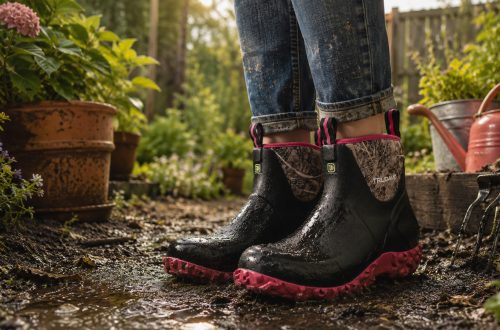
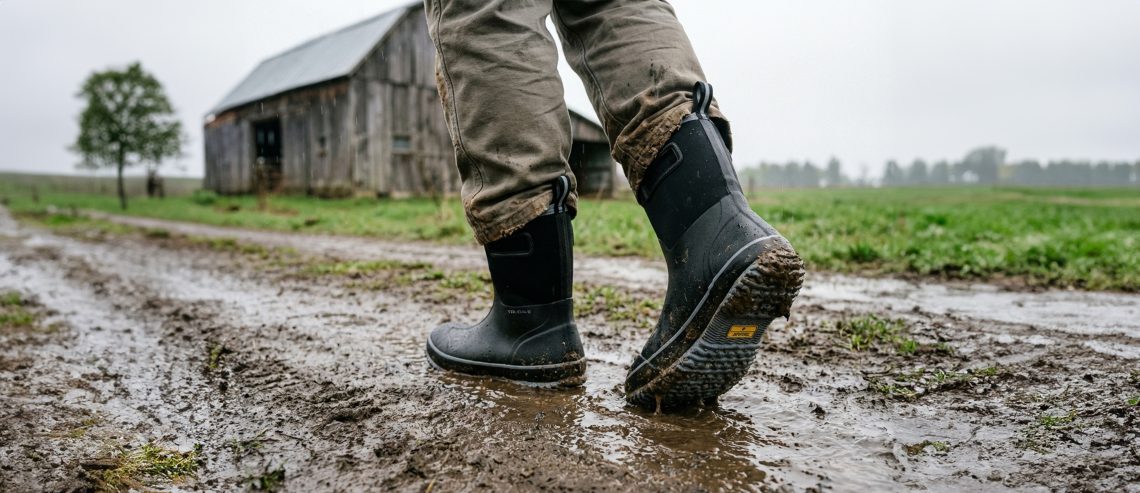
The defining feature of the GardenStride is its deep, open lug outsole. These lugs are not the shallow, tightly-spaced tread of a commuter boot. They’re widely spaced and aggressively deep, designed to bite into saturated soil, churned mud, and loose gravel—and then, crucially, to release that material cleanly with every step. This self-cleaning action is the difference between a boot that maintains traction through a long day of mucking stalls and one that becomes a five-pound mud brick within fifty yards of the barn. The channels between the lugs are wide enough to eject sticky clay and manure, preventing the buildup that turns lesser boots into skating rinks.
The upper is fully vulcanized natural rubber. Vulcanization—the chemical cross-linking of rubber polymers with sulfur and heat—creates a single, continuous waterproof barrier. There are no glued seams to separate after repeated flexing in cold, wet conditions. There are no stitches to rot. The mid-calf height protects against splashes, shallow flooding, and the kind of muck that tries to creep over the top of a shorter boot.
Inside, the GardenStride features a cushioned EVA insole and a breathable lining. This is not the flat, unsupportive footbed found in cheap chore boots. The EVA midsole provides shock absorption and arch support, reducing the fatigue that comes from standing and walking on hard, uneven ground for hours at a stretch. The insole is removable, so you can swap in your own orthotics or an aftermarket insole if you need more support. The interior volume is generous—designed to accommodate the thick wool socks that cold-weather chores demand.
The GardenStride is the boot for deep mud, manure, drainage ditches, fence repair in saturated pastures, and the thousand other wet, filthy tasks that define life on a working farm or homestead. It’s not insulated, so in freezing conditions you’ll rely on your sock system for warmth. But for the other nine months of the year, when the ground is soft and the muck is deep, it’s the right tool for the job.
Part 2: The AquaGuard — The Industrial Protector
If the GardenStride is built for the farm, the AquaGuard is built for the job site. It shares the same vulcanized natural rubber foundation, the same mid-calf height, and the same 100% waterproof construction. But the rubber itself is different. The AquaGuard uses an industrial-grade rubber compound that is thicker, denser, and specifically formulated to resist degradation from diesel, gasoline, hydraulic fluid, and the caustic cleaning agents used on commercial vessels and construction sites.
This chemical resistance is the AquaGuard’s defining advantage. Standard rubber boots—even heavy-duty ones—can soften, swell, or crack when exposed to fuels and industrial solvents. The AquaGuard’s rubber is engineered to hold its integrity in environments where those substances are a daily reality. For the commercial fisherman working on a deck slicked with diesel and fish oil, the dock builder pouring concrete and setting pilings, the mechanic working in a wet, oily shop, or the construction worker whose job site turns into a clay pit after every rain, this chemical resistance is not a luxury—it’s a safety feature.
The outsole is built for industrial surfaces. It features a non-slip tread pattern designed to grip on wet concrete, metal grating, and the diamond-plate surfaces common on commercial vessels and construction equipment. The deep lugs provide traction in mud and loose soil, but the tread is tuned for the hard, slick surfaces that define industrial work. It’s oil-resistant and self-cleaning, shedding debris with each step.
Comfort is not sacrificed for toughness. The AquaGuard has a cushioned EVA midsole with ergonomic arch support—a design element borrowed from Trudave’s hunting and deck boot lines—that reduces the lower back and knee fatigue that comes from standing on hard surfaces for ten, twelve, fourteen hours. There is no steel shank to conduct cold or add weight. The toe and heel areas are reinforced with thicker rubber overlays to protect against dropped tools, anchor chains, and the general physical punishment of a demanding work environment. The reinforced heel also features an easy-off tab for hands-free removal at the end of a long shift.
Like all Trudave boots, the AquaGuard’s insole is removable. For workers with high arches, flat feet, or simply the need for more cushioning, Trudave’s ToughCush Comfort Insole is a direct upgrade that adds ergonomic support and a shock-absorbing heel pad.
The AquaGuard is the boot for the worker whose job site involves fuel, chemicals, heavy machinery, and the kind of physical abuse that destroys standard rubber boots within weeks.
Part 3: Head-to-Head Across the Toughest Tasks
To understand which boot belongs on your feet, let’s run them through the specific tasks that define heavy outdoor and industrial work.
Deep Mud and Manure
The GardenStride is the clear winner here. Its deep, open lugs are specifically designed to bite into saturated soil and manure, then release it cleanly. The self-cleaning tread pattern prevents the mud buildup that adds weight and reduces traction. The AquaGuard can handle mud—its lugs are no slouches—but its tread is tuned more for hard industrial surfaces. For mucking stalls, clearing drainage ditches, or working in saturated pastures, the GardenStride is the specialist. As Trudave describes it: “If your day involves deep mud, manure, or standing water, you need a seal, not a sieve.”
Standing Water and Flooded Areas
Both boots are 100% waterproof with vulcanized seams. The mid-calf height on both provides clearance for standing water up to about a foot deep. Neither is a wading boot—for water deeper than mid-calf, you need a taller shaft or waders—but for the flooded gateways, backed-up culverts, and standing puddles of a working farm or job site, both will keep your feet dry. The GardenStride’s self-cleaning lugs give it a slight edge in mucky standing water; the AquaGuard’s oil-resistant outsole gives it the edge in water contaminated with fuel or chemicals.
Chemicals, Fuel, and Industrial Contaminants
The AquaGuard is the undisputed choice here. Its industrial-grade rubber is formulated specifically to resist degradation from diesel, gasoline, hydraulic fluid, and harsh cleaning agents. The GardenStride’s rubber is tough and durable, but it is not chemically resistant in the same way. If you work on a commercial fishing vessel, a construction site with heavy equipment, a mechanic’s shop, or any environment where fuel and solvents are part of the daily picture, the AquaGuard is the boot that will survive. The GardenStride, exposed to the same chemicals, will degrade faster.
All-Day Standing on Hard Surfaces
Both boots feature EVA midsoles and cushioned insoles. The AquaGuard adds ergonomic arch support that makes a meaningful difference during 12-hour shifts on concrete and metal. For the worker standing at a processing table, a construction site, or a factory floor, the AquaGuard’s additional support architecture reduces the cumulative fatigue that leads to back pain and foot injuries. The GardenStride is comfortable for long days of varied movement—walking, bending, hauling—but it doesn’t have the same tuned support for static standing.
Winter and Cold-Weather Work
Neither the GardenStride nor the AquaGuard is insulated. In freezing temperatures, you’ll rely on your sock system to provide warmth. Both boots have generous interior volume designed to accommodate heavyweight merino wool socks. For extreme cold, Trudave’s HeatHold—with its 5mm insulated neoprene lining—is the dedicated winter boot. The GardenStride and AquaGuard are three-season workhorses that can extend into winter with the right sock system, but they are not built to replace an insulated boot in sustained sub-freezing conditions.
Durability and Lifespan
Both boots are built to last. The vulcanized natural rubber construction means there are no glued seams to separate, no stitches to rot. With proper care—rinsing off mud, manure, salt, and chemicals after each use, air-drying at room temperature away from direct heat—both boots can deliver five or more seasons of hard service. The AquaGuard’s industrial-grade rubber may extend its lifespan in chemically aggressive environments; the GardenStride’s specialized tread may wear faster on abrasive concrete and asphalt than on soft ground.
Part 4: The Real-World Voices
The best evidence for which boot works where comes from the people who wear them. On Trustpilot, where Trudave maintains a “Great” rating of 4.1 out of 5, patterns emerge.
A dairy farmer who wears the GardenStride daily wrote: “I’m in mud and manure from 5 a.m. until dark. These boots have held up through two springs of constant abuse. The tread still grips, the rubber hasn’t cracked, and my feet stay dry. I used to buy a new pair of chore boots every spring. These are on their third year.”
A commercial lobsterman who switched to the AquaGuard reported: “Diesel, bait, hydraulic fluid—my old boots would get soft and crack within six months. The AquaGuards have lasted a full season and they’re still going. The grip on a wet steel deck is better than anything I’ve worn.”
A homesteader who uses both boots for different tasks described her system: “GardenStrides for the paddock, the chicken run, and the compost pile. AquaGuards for pressure-washing, working on the tractor, and anything involving fuel or chemicals. They’re different tools for different jobs, and I’m glad I have both.”
Part 5: The Care That Protects the Investment
Heavy-duty boots face heavy-duty abuse, and the care protocol matters. For both the GardenStride and the AquaGuard, Trudave’s guidance is consistent: rinse thoroughly with fresh water after every use, especially after exposure to salt, manure, fuel, or chemical runoff. Use a mild soap and soft brush for stubborn grime. Remove the insoles to dry separately. Air-dry the boots upright at room temperature, away from direct sunlight and heat sources. Never put them near a radiator, a campfire, or in a hot vehicle—heat is the enemy of vulcanized rubber.
For the AquaGuard, the post-use rinse is especially important. Diesel, gasoline, and hydraulic fluid left on the rubber will accelerate degradation, even with an industrial-grade compound. A thorough freshwater rinse and a periodic conditioning with a silicone-free rubber conditioner will keep the boots supple, waterproof, and resistant for years.
Part 6: The Decision Framework
| Your Work Profile | Primary Conditions | Best Trudave Boot | Key Reason |
|---|---|---|---|
| Farming, ranching, homesteading | Deep mud, manure, standing water | GardenStride | Self-cleaning deep lugs, full waterproofing |
| Commercial fishing, construction, mechanics | Fuel, chemicals, hard industrial surfaces | AquaGuard | Industrial-grade rubber, chemical resistance, slip-resistant outsole |
| Mixed heavy outdoor work | Combines mud, water, and occasional chemical exposure | Two-boot system | GardenStride for mud and muck, AquaGuard for chemicals and hard surfaces |
| Cold-weather versions of the above | Freezing temps, snow, frozen ground | HeatHold (or GardenStride/AquaGuard + heavyweight socks) | 5mm neoprene insulation for static warmth |
For the worker whose job crosses multiple domains—say, a farmer who also maintains heavy equipment, or a commercial fisherman who works on both the boat and the dock—the two-boot system is not overkill. It’s matching the right tool to the right hazard. At Trudave’s direct-to-consumer pricing, owning both a GardenStride and an AquaGuard costs less than a single pair of premium industrial boots from a legacy brand sold through traditional retail.
Conclusion: The Right Hammer for the Right Nail
A carpenter doesn’t use a framing hammer for finish work. A chef doesn’t use a cleaver to fillet a fish. And the worker whose boots have to survive diesel, manure, standing water, or 14-hour shifts on concrete shouldn’t use a boot that was designed for walking the dog in the rain.
Trudave Gear built the GardenStride and the AquaGuard for the heavy end of the work spectrum. The GardenStride bites into deep mud and releases it cleanly. The AquaGuard stands up to the chemicals and hard surfaces that chew up lesser rubber. Both are built from vulcanized natural rubber with sealed seams and cushioned EVA midsoles. Both are 100% waterproof. Both are sold at direct-to-consumer prices that make buying the right tool for the job an affordable choice rather than a financial sacrifice.
The right boot doesn’t just keep your feet dry. It keeps you safe, keeps you productive, and keeps you working. Choose the one that matches your mud.
To explore the complete Trudave Gear rain and work boot lineup and find the right pair for your toughest jobs, visit trudavegear.com.


You May Also Like
Small Ranch, Huge Output: Winter Systems That Cut Chores in Half
How Soil Temperature Controls What You Can Plant Right Now