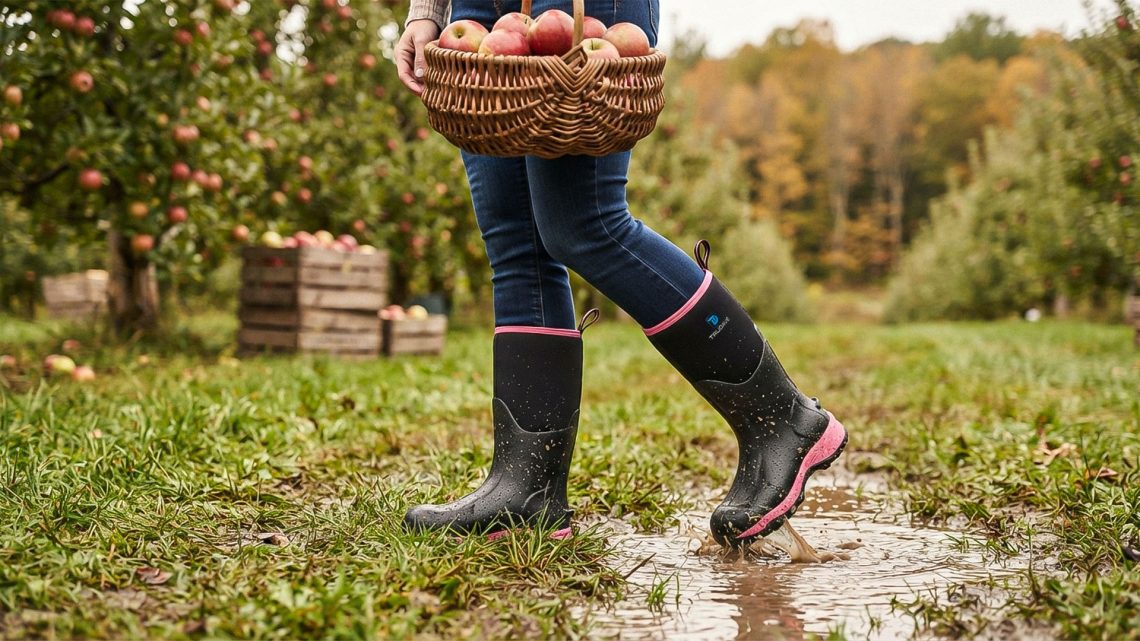
Best Boots for Apple Orchard and Cider Mill Work
Apple orchard work combines wet grass, mud, ladders, fruit bins, tractors, irrigation systems, packing sheds, cold storage, cider processing, and long harvest shifts that often begin before the ground has dried from overnight dew.
During peak season, a worker may start the morning checking orchard rows, walk through wet grass to picking blocks, climb ladders, carry harvest bags, move bins, repair irrigation, help with sorting and packing, and finish the day around a cider press or washdown area.
Footwear may encounter:
- Wet orchard grass.
- Mud.
- Fallen apples.
- Irrigation water.
- Gravel farm roads.
- Ladder rungs.
- Fruit bins.
- Concrete packing floors.
- Cider residue.
- Wash water.
- Cold-storage floors.
- Autumn rain.
That makes footwear an important part of apple production.
The best boots for apple orchard workers should provide dependable water protection, comfortable support for long walking routes, stable traction on wet grass and mud, secure fit for ladder work, and enough versatility to move between orchard rows, harvest equipment, packing sheds, and cider-processing areas.
Apple Harvest Often Starts on Wet Ground
Orchard work frequently begins early.
At that time, grass between tree rows may be covered with:
- Heavy dew.
- Overnight rain.
- Irrigation moisture.
Workers can soak low-cut shoes before picking even begins.
Mid-height waterproof boots help keep socks dry through the first hours of the shift.
Wet Grass Is a Bigger Problem Than It Looks
Orchard grass holds water against footwear with every step.
Even without standing water, workers may repeatedly brush against:
- Tall grass.
- Low branches.
- Ground vegetation.
A waterproof upper is therefore useful even on days with clear weather.
Apple Orchard Work Requires Mixed-Surface Footwear
A worker may move between:
- Grass.
- Mud.
- Gravel.
- Concrete.
- Ladder rungs.
- Tractor platforms.
A boot designed only for deep mud may feel awkward on ladders and packing floors.
A flat indoor shoe may struggle in wet orchard rows.
For many workers, moderate mixed-surface tread provides the best balance.
Boots for Apple Pickers
Apple pickers may spend entire days:
- Walking.
- Climbing.
- Reaching.
- Carrying fruit.
Footwear should prioritize:
- Waterproof construction.
- Secure heel fit.
- Low unnecessary weight.
- Flexible forefoot movement.
- Strong cushioning.
Boot Weight Matters During Picking
Harvest workers may take thousands of steps.
Heavy footwear increases fatigue.
A lighter waterproof work boot can be more practical than an oversized farm boot when fields are not deeply muddy.
Boots for Orchard Ladders
Apple picking often requires tripod or orchard ladders.
Workers need precise foot placement.
Useful features include:
- Defined heel edges.
- Moderate outsole thickness.
- Secure heel retention.
Deep Mud Lugs Can Be Awkward on Ladder Rungs
Aggressive agricultural tread may reduce precise contact with narrow ladder steps.
Workers who frequently climb should avoid unnecessarily bulky outsoles.
Secure Fit Matters on Ladders
Loose boots may shift internally while the worker climbs.
Heel movement can make foot placement less predictable.
Boots for Harvest Bags
Pickers may carry heavy fruit bags while climbing or walking.
Because both hands may be occupied, stable footing becomes more important.
Boots for Carrying Apples
A full picking bag adds substantial weight.
Workers need footwear with:
- Supportive midsoles.
- Stable heels.
- Good balance.
Boots for Muddy Orchard Rows
Autumn rain can turn orchard lanes into:
- Soft soil.
- Mud.
- Ruts.
- Puddles.
Open tread channels help release soil.
Best Tread for Orchard Mud
Useful outsole features include:
- Moderate lugs.
- Wide channels.
- Defined heel edges.
- Flexible rubber.
The tread should provide traction without becoming unnecessarily heavy.
Boots for Clay Orchards
Wet clay can quickly fill narrow outsole grooves.
Once packed, the sole may become:
- Heavy.
- Smooth.
- Harder to clean.
Wider tread spacing is more practical.
Boots for Sandy Orchards
Well-drained sandy orchards generally require less aggressive tread.
Workers may benefit from lighter footwear.
Boots for Sloped Orchards
Some orchards are planted on hills.
Workers may pick or maintain trees on:
- Side slopes.
- Uneven grass.
Ankle support becomes more important.
Heel Retention Matters on Side Slopes
A secure heel helps prevent the foot from sliding inside the boot.
Loose pull-on footwear may feel unstable on repeated hillside walking.
Boots for Fallen Apple Areas
During harvest, fruit may fall onto the ground.
Crushed apples can create slick spots.
Workers should avoid stepping directly onto damaged fruit whenever possible.
Fruit Residue Can Reduce Traction
No outsole eliminates the risk created by crushed fruit.
Good housekeeping around:
- Packing areas.
- Cider operations.
is especially important.
Boots for Orchard Irrigation Crews
Apple orchards may use:
- Drip lines.
- Micro-sprinklers.
- Irrigation pipes.
- Pumps.
Workers repairing these systems frequently encounter wet soil.
Boots for Drip-Line Repairs
Workers may kneel or crouch around trees.
Flexible waterproof boots improve comfort.
Boots for Sprinkler Maintenance
Water leaks can create localized mud.
Mid-height or mid-calf boots are useful.
Boots for Irrigation Pump Stations
Larger orchards may use pumps and electrical controls.
Workers may encounter:
- Wet concrete.
- Mechanical equipment.
Structured safety footwear may be appropriate.
Waterproof Does Not Mean Electrical Protection
General waterproof footwear is not automatically electrically rated.
Electrical tasks require appropriate PPE.
Boots for Apple Tree Pruning
Orchard work continues outside harvest season.
Pruning crews may work through:
- Wet winter grass.
- Mud.
- Cold conditions.
Waterproof boots remain useful.
Boots for Winter Pruning
Moderate insulation may be helpful depending on climate.
Workers should avoid overly bulky boots if frequent ladder climbing is required.
Boots for Orchard Shears and Hand Tools
Workers using cutting tools should maintain stable footing.
Footwear does not replace proper tool-handling procedures.
Boots for Orchard Mowing Crews
Grass between rows may require regular mowing.
Workers may operate:
- Tractors.
- Mowers.
- UTVs.
Pedal control matters.
Boots for Tractor Operators
Very tall loose rubber boots may feel awkward on pedals.
A structured mid-height waterproof boot often works better.
Boots for UTV Operators
UTVs may be used for:
- Scouting.
- Tool transport.
- Harvest support.
Workers need footwear that balances:
- Pedal control.
- Outdoor traction.
Boots for ATV Orchard Work
Moderate outsole thickness improves foot-control feel.
Boots for Orchard Sprayer Operators
Apple production may involve crop-protection applications.
Footwear requirements depend on the actual chemical used.
Waterproof Does Not Mean Chemical Resistant
General waterproof boots should not automatically be considered suitable for:
- Fungicides.
- Insecticides.
- Herbicides.
Workers should follow product-label and employer PPE requirements.
Boots for Fertilizer Work
Workers handling fertilizers may require footwear compatible with the actual material and concentration.
Boots for Orchard Scouting
Crop scouts may inspect trees for:
- Insects.
- Disease.
- Fruit quality.
- Water stress.
They may cover large orchard blocks.
Lightweight waterproof boots reduce fatigue.
Boots for Fruit-Thinning Crews
Before harvest, workers may thin developing fruit.
This may involve:
- Long walking routes.
- Ladder work.
Comfort and secure ladder contact are important.
Boots for Orchard Floor Maintenance
Workers may manage:
- Grass.
- Mulch.
- Weeds.
- Drainage.
A versatile waterproof outdoor boot works well.
Boots for Mulched Tree Rows
Mulch can become trapped in deep tread.
Moderate open channels are easier to clean.
Boots for Weed-Control Crews
Workers may walk long rows through wet vegetation.
Mid-height waterproof footwear is practical.
Boots for Fence Maintenance
Orchards may use fencing to manage:
- Deer.
- Wildlife.
Workers may handle:
- Wire.
- Posts.
- Fasteners.
Puncture Hazards Matter
A thick outsole is not automatically puncture resistant.
Workers frequently handling wire or nails may need rated protection.
Boots for Deer-Fence Inspections
Perimeter work may involve:
- Wet grass.
- Mud.
- Uneven ground.
Ankle support and mixed-surface tread help.
Boots for Orchard Gate Areas
Repeated tractor traffic can make gates muddy.
More open tread may be useful.
Boots for Apple Bin Handling
Harvested apples may be collected in large bins.
Workers may help:
- Position bins.
- Move them.
- Load them.
Protective-toe footwear may be appropriate.
Boots for Forklift Operators
Forklifts may move full apple bins around:
- Orchards.
- Packing sheds.
Drivers need:
- Good pedal control.
- Secure heel fit.
- Moderate outsole thickness.
Boots for Bin Staging Areas
These areas may contain:
- Gravel.
- Mud.
- Concrete.
Mixed-surface safety footwear works well.
Boots for Orchard Loading Crews
Bins may be loaded onto:
- Trucks.
- Trailers.
Workers need stable footing around heavy equipment.
Safety-Toe Boots for Apple Farms
Protective toes may be useful or required around:
- Forklifts.
- Bins.
- Pallets.
- Machinery.
Routine hand picking may have different needs.
Boots for Apple Packing Houses
Once fruit enters the packing facility, footwear demands change.
Workers may spend hours on:
- Concrete.
- Smooth industrial floors.
Hard-floor cushioning becomes a priority.
Boots for Sorting Lines
Workers may stand for long periods.
Useful footwear features include:
- Supportive midsoles.
- Lower boot weight.
- Moderate tread.
Boots for Apple Washing Lines
Fruit may be washed before packing.
Floors can become wet from:
- Water.
- Fruit residue.
Waterproof hard-floor boots are useful.
Boots for Conveyor Areas
Workers may operate around:
- Conveyors.
- Machinery.
- Wet floors.
Protective toes may be required in some facilities.
Boots for Apple Packing Crews
Packaging workers may move:
- Boxes.
- Trays.
- Pallets.
A structured waterproof safety boot is practical.
Boots for Palletizing
Workers stacking finished boxes may spend hours on concrete.
Strong cushioning helps reduce fatigue.
Boots for Cold Storage
Apples are commonly stored in refrigerated facilities.
Workers may spend time in:
- Cool rooms.
- Cold warehouses.
Cold concrete can become uncomfortable through thin soles.
Boots for Refrigerated Apple Warehouses
Workers may benefit from:
- Thicker midsoles.
- Moderate insulation.
- Moisture-managing socks.
Boots for Controlled-Atmosphere Storage Support
Certain storage areas may have specific access and safety procedures.
Footwear is only one part of facility safety.
Boots for Loading Docks
Packing operations may load apples onto refrigerated trucks.
Workers may move between:
- Wet docks.
- Outdoor rain.
- Cold trailers.
Mixed-surface waterproof safety boots work well.
Boots for Apple Truck Drivers
Drivers may transition between:
- Orchards.
- Packing facilities.
- Distribution centers.
A mid-height waterproof work boot provides good versatility.
Driving Comfort Matters
Very bulky boots may reduce pedal comfort on long routes.
Boots for Cider Mill Workers
Cider production creates another wet environment.
Workers may handle:
- Apples.
- Wash water.
- Presses.
- Pumps.
- Tanks.
Waterproof footwear is useful.
Boots for Apple Washing Areas
Fruit washing can keep floors wet.
Broad outsole contact works well on concrete.
Boots for Cider Press Operators
Workers may stand around:
- Presses.
- Pumps.
- Fruit pulp.
Easy-clean tread is important.
Boots for Pomace Handling
Pressed apple pulp may create:
- Moist organic residue.
- Slippery areas.
Workers should clean spills promptly.
Boots for Cider Processing Floors
Moderate hard-floor tread is more practical than deep outdoor lugs.
Boots for Juice Production
Apple juice facilities may include:
- Tanks.
- Filling systems.
- Washdown.
Waterproof footwear with good concrete cushioning is useful.
Boots for Hard Cider Production
Hard cider facilities may include fermentation and packaging equipment.
Workers may encounter:
- Wet floors.
- Tanks.
- Hoses.
Structured waterproof work boots are practical.
Boots for Fermentation Rooms
Workers may spend long periods on concrete.
Supportive midsoles matter.
Boots for Bottling and Canning Lines
Packaging areas may involve:
- Conveyors.
- Pallets.
- Wet floors.
Safety toes may be appropriate.
Boots for Cider Cellars
Cool processing or storage areas may require more temperature protection.
Boots for Cider Mill Washdown
Cleaning presses and processing areas may involve:
- Hoses.
- Water.
- Foam cleaning.
Mid-height or mid-calf waterproof boots work well.
Pressure Washing Safety
Waterproof boots protect against ordinary splash.
They do not protect against direct high-pressure spray.
Boots for Cider Sanitation Crews
Food-processing sanitation may involve:
- Detergents.
- Sanitizers.
Waterproof Does Not Mean Chemical Resistant
Workers should follow:
- Product labels.
- SDS guidance.
- Facility PPE requirements.
General rubber boots should not automatically be considered chemical-resistant.
Boots for Chemical Mixing Areas
Concentrated cleaning products may require specialized footwear.
Boots for Cider Floor Drains
Processing facilities need effective drainage.
Workers may clean:
- Trench drains.
- Floor drains.
Easy-clean tread is especially useful.
Boots for Farm Market Workers
Many apple orchards also operate:
- Farm stores.
- Pick-your-own operations.
- Fall festivals.
Workers may transition between outdoor fields and public-facing areas.
Boots for Pick-Your-Own Orchards
Employees may help visitors:
- Navigate rows.
- Carry fruit.
- Use wagons.
Lightweight waterproof boots are practical.
Boots for Orchard Tour Staff
Workers may walk continuously through wet grass.
Cushioning and low weight help.
Boots for Pumpkin-and-Apple Festival Operations
Some orchards combine multiple fall attractions.
Workers may encounter:
- Mud.
- Gravel.
- Parking fields.
Mixed-terrain footwear works well.
Boots for Parking Crews
Temporary grass parking areas can become muddy quickly after rain.
Mid-height waterproof boots are useful.
Boots for Hayride Crews
Workers may operate:
- Tractors.
- Wagons.
Pedal control remains important.
Boots for Farm Store Employees
Workers moving between:
- Orchard.
- Retail areas.
may prefer cleaner-looking waterproof footwear.
Boots for Apple Cider Donut Operations
Food-service areas may have separate footwear and sanitation requirements.
Workers should follow facility procedures.
Boots for Orchard Maintenance Shops
Apple farms rely on:
- Tractors.
- Sprayers.
- UTVs.
- Mowers.
- Forklifts.
Mechanics may need industrial safety footwear.
Boots for Mechanical Repairs
Workers may encounter:
- Oil.
- Grease.
- Hydraulic fluid.
Waterproof Does Not Mean Oil Resistant
Outsole material compatibility should be evaluated separately.
Boots for Hydraulic Repairs
Agricultural equipment often uses hydraulic systems.
Oil-resistant outsoles may be useful.
Boots for Diesel Maintenance
Fuel exposure requires appropriate material properties.
Boots for Welding and Fabrication
General waterproof footwear is not automatically suitable around:
- Sparks.
- Hot metal.
Task-specific protection may be required.
Boots for Equipment Washdown
Orchard machinery may collect:
- Mud.
- Leaves.
- Fruit residue.
Workers may clean equipment with:
- Hoses.
- Pressure washers.
Mid-calf waterproof boots provide useful splash coverage.
Boots for Apple Bin Washing
Reusable harvest bins may require cleaning.
Waterproof easy-clean footwear is practical.
Boots for Orchard Drainage Crews
Orchards require drainage around:
- Rows.
- Roads.
- Packing facilities.
Workers may maintain:
- Ditches.
- Culverts.
Boots for Ditch Cleaning
Mid-calf waterproof boots are useful around:
- Mud.
- Standing water.
Boots for Culvert Maintenance
Workers may encounter:
- Gravel.
- Leaves.
- Water.
Strong midsoles and ankle support help.
Boots for Storm Cleanup
Severe storms may cause:
- Fallen branches.
- Damaged trees.
- Flooded rows.
Workers may need more protective footwear.
Boots for Fallen Limb Cleanup
Sharp wood and cutting tools create additional hazards.
Chainsaw Work Requires Specialized Footwear
General waterproof boots should not automatically be considered chainsaw protective.
Cut-resistant forestry footwear may be required.
Boots for Hail-Damaged Orchards
Workers may inspect and clean up damaged fruit or branches.
Uneven debris requires cautious footing.
Boots for Spring Orchard Work
Spring may involve:
- Rain.
- Mud.
- Pruning.
- Irrigation startup.
Waterproof boots are especially useful.
Boots for Summer Orchard Work
Summer may be hot.
Workers should avoid unnecessary insulation.
Useful features include:
- Lightweight construction.
- Moisture-wicking socks.
- Moderate shaft height.
Waterproof Boots Can Still Become Damp Inside
Sweat may create internal moisture.
Daily drying matters.
Boots for Fall Apple Harvest
Autumn is one of the most demanding periods.
Workers may deal with:
- Cold rain.
- Dew.
- Mud.
- Long shifts.
Waterproof mixed-surface boots are particularly valuable.
Boots for Cold Rain
Cool wet weather can make feet uncomfortable quickly.
Moderate insulation and good socks may help.
Boots for Winter Orchard Maintenance
Workers may continue:
- Pruning.
- Equipment service.
- Fence repair.
Cold-region farms may require insulated waterproof footwear.
Boots for Snowy Orchards
Workers may encounter:
- Snow.
- Slush.
- Ice.
Mid-calf insulated waterproof boots may be useful.
Ice Requires Separate Traction Measures
No ordinary work boot completely eliminates ice risk.
Approved traction aids may be needed.
Boots for Long Apple Harvest Shifts
Peak harvest may require long days.
Workers may spend many hours:
- Walking.
- Climbing.
- Carrying.
- Driving.
Comfort becomes increasingly important.
Cushioning Matters Across Orchard and Packing Surfaces
Workers may transition from soft grass to hard concrete.
Supportive midsoles provide more consistent comfort.
Heel Retention Matters in Mud and on Ladders
Secure fit helps reduce internal movement.
Ankle Support Matters on Uneven Rows
Tree roots, ruts, and slopes can challenge stability.
Forefoot Flexibility Helps Pickers
Workers frequently:
- Climb.
- Crouch.
- Bend.
The boot should move naturally.
Toe Room Matters During Long Shifts
Feet may swell.
Enough space improves comfort.
Best Socks for Apple Orchard Workers
Synthetic and wool-blend socks generally perform better than cotton.
Useful features include:
- Moisture wicking.
- Quick drying.
- Heel cushioning.
- Temperature regulation.
Wool-Blend Socks Are Useful During Fall Harvest
Cool wet mornings can make moisture management especially important.
Spare Socks Can Be Useful
Heavy rain or orchard mud may occasionally allow water into footwear.
A dry replacement pair improves comfort.
Removable Insoles Improve Daily Drying
Replaceable footbeds allow workers to:
- Dry boots.
- Restore cushioning.
- Improve hygiene.
- Adjust warmth.
Easy-Clean Construction Is Important
Apple-farm boots may collect:
- Mud.
- Grass.
- Leaves.
- Fruit residue.
- Pomace.
Smooth waterproof uppers simplify cleaning.
How to Clean Apple Orchard Work Boots
A practical routine may include:
- Remove leaves and grass.
- Brush mud from tread.
- Remove crushed fruit residue.
- Rinse ordinary field dirt.
- Follow PPE procedures after agricultural or sanitation chemical exposure.
- Remove damp insoles.
- Allow footwear to dry completely.
Apple Residue Should Be Removed Promptly
Crushed fruit and cider residue can become sticky after drying.
Mud Should Be Removed Before It Hardens
Dried soil can hide tread wear.
How to Dry Orchard Work Boots
After cleaning:
- Remove insoles.
- Open boots fully.
- Allow airflow.
- Use low-temperature drying if approved.
Avoid excessive direct heat.
Rotating Two Pairs Can Help During Harvest
Repeated rain and dew may prevent one pair from drying completely.
Alternating footwear gives each pair more recovery time.
When Apple Orchard Boots Should Be Replaced
Replace footwear when:
- Waterproofing fails.
- Tread becomes badly worn.
- Rubber cracks.
- Outsole separation develops.
- Heel support collapses.
- Puncture damage occurs.
- Safety components are compromised.
- Cushioning becomes ineffective.
Are Rubber Boots Good for Apple Orchard Work?
Yes.
Rubber boots are particularly useful for:
- Wet grass.
- Mud.
- Irrigation.
- Cider washdown.
Workers covering long distances or climbing ladders should also prioritize fit, weight, and underfoot support.
How Tall Should Apple Orchard Boots Be?
Mid-height boots work well for many picking and general orchard tasks.
Mid-calf boots may be better for:
- Deep mud.
- Irrigation repairs.
- Heavy rain.
- Cider washdown.
Do Apple Orchard Workers Need Safety-Toe Boots?
Some bin handling, forklift, loading, maintenance, packing, and cider-processing roles may require protective-toe footwear.
Do Orchard Workers Need Puncture-Resistant Boots?
Puncture protection may be useful around:
- Fence repair.
- Pallets.
- Construction debris.
- Maintenance shops.
Are Waterproof Orchard Boots Suitable for Pesticide Work?
Not automatically.
Workers should follow the PPE requirements for the specific agricultural product being used.
Common Mistakes When Buying Apple Orchard Boots
Wearing Low Shoes Through Wet Orchard Grass
Morning dew can soak them quickly.
Buying Heavy Mud Boots for Full-Day Picking
Excessive weight increases fatigue.
Choosing Boots Too Loose for Ladder Work
Secure fit improves foot placement.
Using Extremely Deep Lugs on Orchard Ladders
Bulky tread can make rung contact less precise.
Ignoring Packing-House Cushioning
Workers may spend hours on concrete.
Assuming Waterproof Means Chemical Resistant
Agricultural and sanitation chemicals may require specialized PPE.
Ignoring Crushed Fruit on Floors
Apple residue can create slippery spots.
Letting Mud and Pomace Build Up in Tread
Regular cleaning helps preserve traction and hygiene.
How to Choose the Best Boots for Apple Orchard Work
Start with the worker’s primary responsibilities.
For apple pickers, prioritize:
- Lightweight waterproof construction.
- Secure heel fit.
- Ladder-friendly moderate tread.
- Strong cushioning.
For irrigation crews, prioritize:
- More shaft coverage.
- Flexible movement.
- Mud-release tread.
For bin and loading workers, prioritize:
- Safety toes where required.
- Mixed-surface traction.
- Strong midsoles.
For tractor and UTV operators, prioritize:
- Pedal control.
- Moderate outsole thickness.
- Secure heel positioning.
For packing-house employees, prioritize:
- Hard-floor cushioning.
- Lower boot weight.
- Moderate easy-clean tread.
For cider-mill workers, prioritize:
- Fully waterproof construction.
- Hard-floor traction.
- Easy-clean uppers.
- Appropriate chemical compatibility.
For maintenance technicians, prioritize:
- Safety ratings.
- Oil, electrical, puncture, heat, or chemical protection according to actual tasks.
Workers comparing waterproof footwear from brands such as Trudave Gear should choose boots according to the actual combination of wet orchard grass, mud, ladder work, harvest loading, packing, cider processing, and long seasonal shifts involved in their job.
Frequently Asked Questions
What are the best boots for apple orchard work?
The best apple-orchard boots are waterproof, lightweight enough for long walking routes, securely fitted, supportive, and equipped with tread suitable for wet grass, mud, gravel, and ladder work.
Are rubber boots good for apple orchards?
Yes. Rubber boots are particularly useful for wet grass, mud, irrigation, rainy harvests, and cider-mill washdown.
What boots are best for apple picking?
Lightweight waterproof boots with strong cushioning, secure heel fit, moderate ladder-friendly tread, and good flexibility are practical.
What boots are best for muddy orchard rows?
Waterproof work boots with open tread channels, ankle support, secure heel retention, and supportive midsoles work well.
Are deep-lug boots good for apple picking ladders?
Usually not. Moderate tread generally provides more precise contact with orchard ladder rungs.
Do orchard workers need safety-toe boots?
Some forklift, apple-bin, packing, loading, maintenance, and cider-processing roles may require protective-toe footwear.
What boots are best for cider mill work?
Waterproof work boots with broad hard-floor contact, good cushioning, easy-clean construction, and task-appropriate chemical compatibility are practical.
Are waterproof orchard boots chemical resistant?
Not automatically. Agricultural chemicals and sanitation products may require specialized PPE.
What boots are best for wet fall harvests?
Mid-height waterproof boots with secure heel fit, moderate outdoor tread, supportive midsoles, and temperature-appropriate socks are practical.
How should apple orchard boots be cleaned?
Remove grass, leaves, mud, fruit residue, and pomace, clean tread grooves, follow workplace procedures after chemical exposure, and allow footwear to dry completely.
Final Thoughts
Apple orchard and cider-mill work combines wet grass, mud, ladders, irrigation, fruit bins, tractors, packing houses, cold storage, cider processing, washdown, and long fall harvest shifts.
The best footwear depends on the worker’s actual role.
Apple pickers need lightweight waterproof boots with secure fit and ladder-friendly tread.
Irrigation crews benefit from additional waterproof coverage.
Bin and loading workers may require protective toes.
Equipment operators need reliable pedal control.
Packing-house workers need strong concrete cushioning.
Cider-mill employees need waterproof easy-clean footwear suitable for wet processing floors.
Maintenance technicians may require additional oil, electrical, puncture, chemical, or task-specific protection.
Trudave Gear offers waterproof outdoor and work footwear suited to rain, wet grass, mud, agricultural work, packing areas, and demanding seasonal environments.
Choosing footwear according to the actual apple-production task can help workers stay drier, reduce fatigue, maintain better footing, and remain more comfortable from the first dew-covered orchard walk before sunrise to the final cider press cleanup after a long fall harvest day.


You May Also Like
The Late Spring Growth Surge That Can Backfire Quickly
Spring Crop Rotation Tips for Healthy Soil