-
The First Week: What New Trudave Rain Boot Owners Should Actually Expect — A Break-In Guide for Rubber and Neoprene
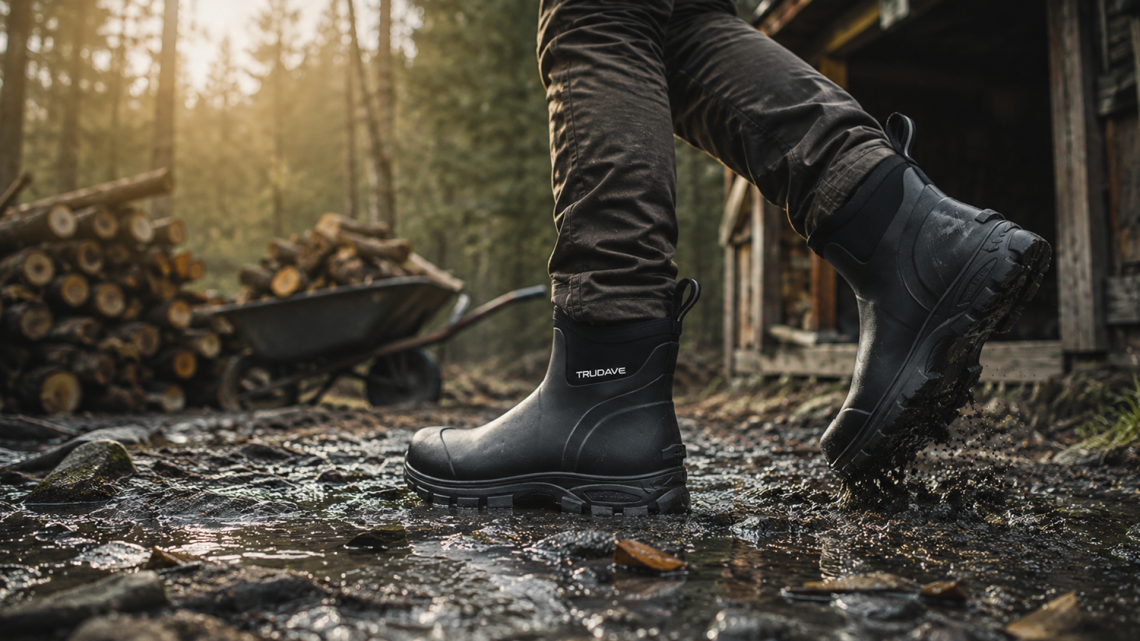
Introduction: The Myth of the Painful Break-In There’s a piece of folk wisdom that gets passed around gardening forums, homesteading groups, and farm supply store aisles every spring. It goes something like this: “New rubber boots need to be broken in. Wear thick socks. Expect blisters for the first week. They’ll soften up eventually.” This advice was probably true in 1975, when most rain boots were made from stiff, unforgiving PVC that had all the flexibility of a plastic bucket. But it’s not true anymore. The materials have changed. The construction has changed. And the idea that you need to suffer through a week of pain before your boots become…
-
The “Get Out the Door” Guide: How Trudave Gear Rain Boots Eliminate the Friction Between You and Your Outdoor Life
Introduction: The Three-Minute Battle There’s a small, unremarkable war that plays out in mudrooms and back porches across America every morning. It lasts about three minutes, but its outcome determines whether you start your day frustrated or focused. It goes like this: you need to let the chickens out, walk the dog, or water the garden before work. You reach for your old rain boots—the ones that cost $30 at the big-box store. They’re cold, stiff, and still damp from yesterday because they never fully dry. You wrestle them on. The heel folds under instead of sliding in. You sit down on the bench to yank them up, then stand…
-
Beyond the Boot — How Trudave Gear Built a Complete Rain Boot System, and Why the Little Details Make the Biggest Difference
Introduction: The Boot Tray Epiphany There’s a moment every serious gardener, farmer, or homesteader eventually experiences. It usually happens while standing at the back door, one hand on the frame for balance, the other wrestling a stiff rubber boot off a wet sock while mud crumbles onto the floor you just cleaned. You look down at the growing pile of boots by the door—the leaky pair you should throw away, the stiff pair you never wear, the insulated pair that’s too hot half the year—and you think: there has to be a better way. That moment is what separates people who buy boots from people who build a boot system. A…
You May Also Like

Maximizing Pasture Growth in Early Summer: Tips for Healthy Grasslands
Deck Boots for Kayak Anglers and Small Boat Fishermen: Why Your Setup Demands a Different Boot Than Tournament Guys Use
The $30 Rain Boot Tax: Why Cheap Boots Are Actually the Most Expensive Purchase You’ll Make
-
The $7 Problem: How the Right Insole and the Right Fit Turn a Good Trudave Rain Boot Into a Great One
Introduction: The Boots That Fit Everyone and No One There’s a quiet frustration familiar to anyone who has ever bought a pair of rubber rain boots online. The boots arrive. You pull them out of the box. They look exactly like the photos. You slide your foot in—and something is off. The length feels right, but the heel slips with every step. Or the arch doesn’t quite hit where your arch actually is. Or the ball of your foot feels like it’s swimming in rubber that was molded for someone else’s skeleton entirely. The problem isn’t that the boots are poorly made. It’s that they’re made for a hypothetical “average”…
-
Built for the Mud, Not the Mall: What Happened When I Gave Trudave Boots to a Farmer, a Gardener, and a Hunter
Introduction: The Boots That Never Went Back in the Box There’s a particular kind of gear review that has become the industry standard, and it usually goes like this: unbox the product, wear it around the house for a few hours, maybe walk the dog through a puddle, and declare it “excellent.” The boots look pristine in the photos. The reviewer’s socks are dry. The conclusion is glowing. And the person reading the review has absolutely no idea whether the boots will survive a single season of actual outdoor work. I wanted to do something different. Instead of a traditional review, I gave three pairs of Trudave Gear boots to…
-
The Complete 2026 Guide to Trudave Rain Boots: From Garden Beds to Frozen Fields, Which Pair Is Engineered for Your Life?
The global rain boot market is projected to reach $2.4 billion by 2030, growing at a steady 4.5% annually. That‘s a lot of rubber. A lot of factories. And, frankly, a lot of boots that all look the same at a glance. Yet if you’ve spent any time in online reviews or standing in a muddy paddock at 6 a.m., you know the truth: the difference between a boot that becomes your go-to for years and one that cracks by spring isn‘t the color or the logo—it’s the engineering beneath your foot. For decades, the industry presented a simple, misleading choice: spend 200onapremium−brandbootorriskwet,frozenfeetina200onapremium−brandbootorriskwet,frozenfeetina30 PVC shell from a big-box store. This binary…
-
The Slip-On Revolution — Why Trudave Gear Is Redefining What a Rain Boot Should Feel Like, Fit Like, and Do
You know the scene. It’s 5:00 AM. The dog is pacing by the back door. The grass outside is soaked with the kind of heavy dew that soaks through sneakers in under thirty seconds. You’re standing there, still half-asleep, staring at a pair of lace-up boots that require two hands, a bent knee, and enough fine motor control to thread wet laces through frozen eyelets. And somewhere in the back of your mind, a quiet voice asks the question that has launched a thousand gear revolutions: is this really necessary? If you’ve spent any time on the outdoor corners of TikTok lately, you’ve seen the debate unfold in real time. The…
-
Mud, Sweat, and She-Sheds: How Trudave Gear Is Finally Giving Women the Rain Boots They Deserve
The global rubber rain boot market is projected to reach $2.5 billion by 2035, growing steadily at 3.7% annually. That’s a lot of rubber. A lot of factories. A lot of shipping containers crossing oceans. And yet, for most of that market’s history, the women buying those boots were an afterthought—handed shrunken versions of men’s designs, offered fewer color options, and largely ignored by an industry that seemed to believe “waterproof” was the only feature that mattered. That era is ending. Not quietly, but definitively. In 2025, John Deere—a brand synonymous with American agriculture for nearly two centuries—partnered with Dovetail Workwear to launch a collection of apparel and gear specifically…
-
The Care and Feeding of Your Trudave Rain Boots — How to Turn a 2-Season Boot Into a Decade-Long Companion
Introduction Here’s a quiet truth about outdoor gear that the industry rarely says out loud: the most sustainable, cost-effective boot you’ll ever own isn’t the one with the flashiest technology or the highest price tag. It’s the one you already have on your feet — provided you know how to take care of it. Walk into any farm supply store in America, and you’ll see the same graveyard: racks of cheap rubber boots, PVC shells cracking at the flex points, destined for the landfill before the year is out. The average pair of low-quality rain boots lasts 2.1 years before the waterproofing fails, the soles wear smooth, or the seams…
-
Beyond the Logo Tax — How Trudave Gear Is Redefining What a Rain Boot Should Cost, Feel, and Survive in 2026
Walk into any big-box outdoor retailer in America, and the narrative hits you before you even reach the footwear aisle: if you want a reliable, 100% waterproof boot, prepare to hand over 180to180to250. The massive displays are there. The celebrity endorsements are there. The glossy logos are there. But when you strip away the branding and actually examine what you‘re buying, a question surfaces that the industry would prefer you didn’t ask: are you paying for a better boot, or are you just paying a massive “Logo Tax”? At Trudave Gear, we decided to break the traditional retail mold. Let‘s have an honest, transparent conversation about how outdoor footwear is priced,…